
by YANG Shuhongji
When news broke earlier this year that seven Middle Eastern tourists had gone on a shopping spree in Shanghai, filling more than 40 suitcases, one local brand stood out among their purchases.
At a store in Zhangyuan, they ordered dozens of high-priced cashmere headscarves from Sandriver, a Shanghai-based label that positions itself in the top tier of the luxury market.
Founded in 2012, Sandriver began as a cashmere original equipment manufacturer producing for international luxury houses. After more than a decade building up supply chain and production expertise, founder GUO Xiuling shifted the focus to developing an independent brand aimed squarely at the global luxury segment.
The timing was bold. For years, most Chinese consumer brands have clustered in the mass or "affordable luxury" segments, with limited presence in the highest tier of global fashion. According to Bain & Company's 2025 China luxury market report, the number of domestic high-end brands has nearly tripled over the past five years across jewelry, apparel and beauty. Yet Euromonitor data shows Chinese brands account for less than 1.5% of the global personal luxury goods market in 2025, mostly in entry-level categories or products with strong cultural symbolism.
Luxury, after all, is as much about narrative and heritage as product quality. European houses often trade on more than a century of history and instantly recognizable symbols.
Sandriver's response has been to build its identity around China's intangible cultural heritage.
"We did not simply extract heritage symbols," GUO told Jiemian News. "We intervened systematically in the craft itself to reactivate it."
The company draws on traditional crafts such as Inner Mongolian felt-making, Tibetan pulu weaving and Hani embroidery. At the same time, it uses German Stoll knitting machines and 3D seamless technology, seeking to balance cultural distinctiveness with manufacturing precision.

One of its signature lines uses handwoven pulu fabric, with each bolt taking weeks for a skilled artisan to complete. Some coats are made with zero-cutting, seamless construction to reduce material waste and enhance comfort. The names of individual weavers appear on product labels, underscoring the artisanal element.
Since 2020, Sandriver has entered high-end retailers such as Le Bon Marché in Paris and Neiman Marcus in the United States. By the end of 2025, overseas sales accounted for nearly 40% of revenue, with Europe and North America as key markets, according to public disclosures.
The brand has also pursued selective expansion. Rather than rapid store rollouts, it has opted for what GUO describes as "point-based penetration," targeting high-net-worth consumers. In addition to Paris and New York, Sandriver has opened a boutique at the Mount Everest base camp and supplies products to Aman resorts, reinforcing an image of understated exclusivity.
Annual new product launches are kept below 180 items, a deliberate attempt to avoid fast-fashion-style turnover.
Sandriver's growth has coincided with policy support in Shanghai for developing local fashion brands. During the 14th Five-Year Plan period, the city promoted the revitalization of intangible heritage and the integration of cultural industries with consumer markets. In 2023, Shanghai introduced an action plan encouraging companies to combine heritage crafts, digital technologies and green manufacturing.
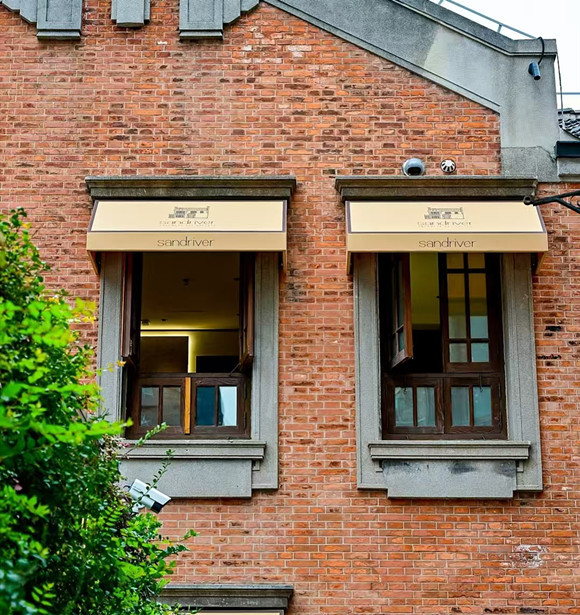
In 2025, Jing'an district rolled out measures offering incentives of up to 1 million yuan (US$140,000) for qualifying local brands opening flagship stores. GUO said Sandriver's global flagship in Zhangyuan benefited from such support.
"Sandriver, as a key local brand supported by Jing'an district, will directly engage with first-tier brands here," she told Jiemian News.
Despite rising visibility, GUO acknowledged that the company's overall scale and profitability remain modest compared with established European houses. Still, she argued that integrating heritage revitalization, vertical supply chain control and selective channel innovation would be central to its next phase.
"This will be an important element in further opening the door to the international luxury market," she said.
For Sandriver, the experiment is ongoing — and the path to enduring global recognition is likely to be long and uncertain.