

by MA Yueran
A reported close-approach incident involving Chinese and US satellites came under scrutiny after a SpaceX executive raised questions over coordination during a recent satellite deployment, drawing responses from Chinese commercial space companies involved in the mission.
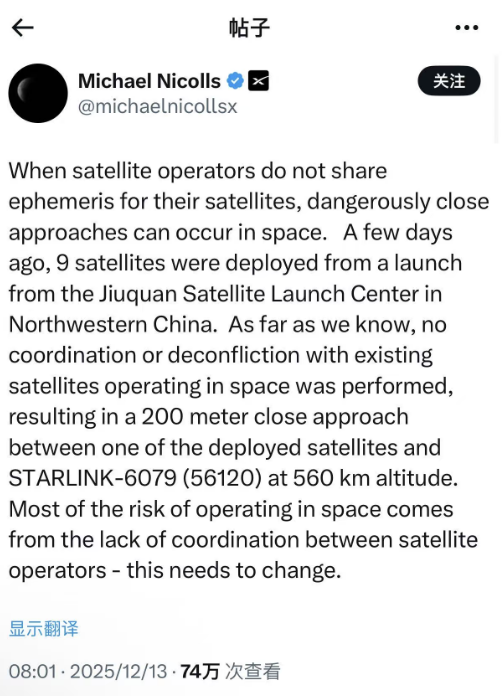
On Dec 13, Michael Nicolls, vice-president of SpaceX's Starlink program, said on social media platform X that a batch of Chinese satellites had been deployed without prior coordination to avoid spacecraft already in orbit.
According to Nicolls, nine satellites were launched several days earlier from Jiuquan Satellite Launch Center in northwestern China. During deployment, he said, the satellites came into a close approach at an altitude of about 560 km, with the minimum distance between one satellite and Starlink-6079 narrowing to about 200 meters.
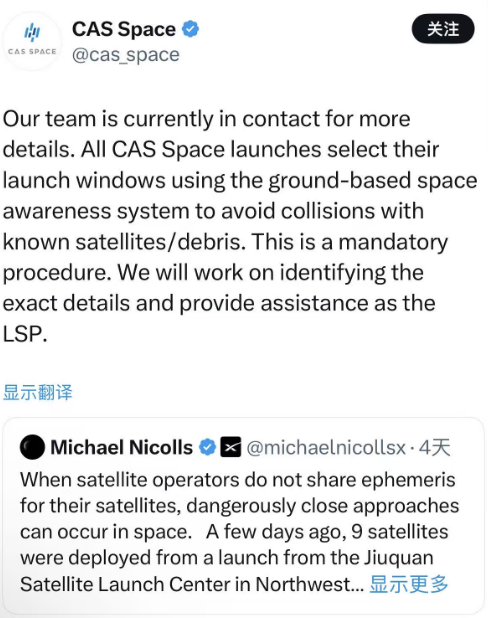
CAS Space, the launch service provider for the mission, said later that day that it was contacting relevant parties for more details. It said that all its launches use ground-based space situational awareness systems to select launch windows and avoid known satellites and debris, calling this a mandatory procedure.
In a subsequent post, CAS Space said that if the close-approach event occurred about 48 hours after payload separation, the launch mission would have already been completed. Any further coordination, it said, would therefore fall to the satellite operators.
Jiemian News learned that Emposat Co., Ltd., China's largest commercial tracking, telemetry and command (TT&C) company, provided TT&C services for nearly all the satellites involved in the launch.
CAO Meng, vice-president of Emposat, told Jiemian News that the distance cited by SpaceX needs further verification. He noted that US tracking of Chinese space objects relies on external observation methods, whose accuracy may be uncertain.
Cao said the episode has also been used by SpaceX to call on satellite operators, both domestic and foreign, to make their ephemeris data public. He added that collision-avoidance rules and data-sharing cannot be handled at the company level alone and need to be addressed through intergovernmental coordination and international rulemaking.
Ephemeris data track a satellite's position and trajectory over time, allowing operators to calculate and predict its location and speed.
Nicolls said that when satellite operators do not share orbital data, dangerous close-approach events can occur, adding that the primary risk to space operations comes from a lack of coordination among operators.
The satellites referenced by SpaceX were launched on Dec 10 aboard the Kinetica 1 Y11 carrier rocket operated by CAS Space, which carried nine satellites on a single launch.
Nicolls later responded, saying he appreciated CAS Space's engagement and looked forward to better coordination in future launches. He reiterated that data sharing among satellite operators is essential.
Satellites underpin global broadband and communications networks, adding pressure to orbital coordination as launch frequency and satellite numbers rise.
According to estimates cited by CSC Financial Co., Ltd, China and the United States could together account for about 85% of global low-Earth-orbit satellite constellations if all planned systems are deployed.
Public data show that more than 13,000 satellites are currently in orbit, with nearly 72% belonging to Starlink. SpaceX has disclosed carrying out about 145,000 collision-avoidance maneuvers in the first half of this year alone.
No binding international framework yet exists to govern space traffic, leaving coordination largely voluntary among countries and satellite operators.