As duty-free venues sink around the world, China's paradise island continues its unrelenting rise. Jiemian news discovers how tax-free tropical incentives are bringing luxury brands home to the mainland's shoppers.

Customers sitting outside the Gucci store in Sanya International Duty-free Shopping Complex. Photos
By ZHANG Xinyu
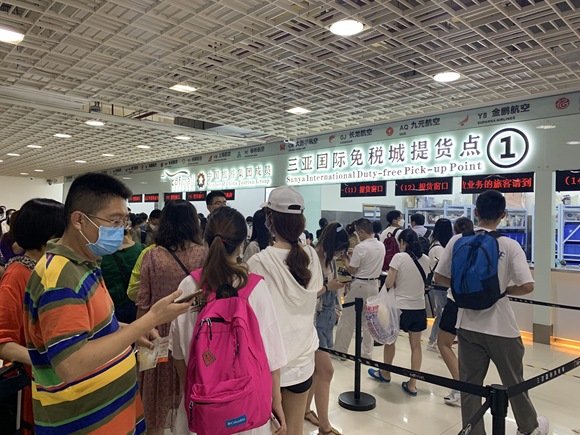
Thousands of tourists blaze their trails through Sanya International Duty-free Shopping Complex every day. In its busiest hours, customers loiter outside the Gucci store for as long as 45 minutes before being admitted through the hallowed portals. A few shops down, the typical customer takes 20 minutes to have their lotions and perfumes scanned and packed at the Lacome checkout.
Chinese consumers have won awesome power in the global luxury market. McKinsey predicts that 40 percent of global luxury purchases will be Chinese within five years. In the pre-pandemic era, the prediction foresaw that 70 percent of this spending would be overseas as these shopping fanatics might have stormed New York, Paris, or Milan.
But as the pandemic grounded many international flights, and with smart footwork in China's tax and pricing regimes had brought Hainan crashing to center stage, with potential and advantages equaling, if not surpassing, Dubai's for example. Cash is flooding into the island from every quarter as governments, brands, hoteliers, and investors write new rules for a new geo-tourism ecology.
From early July, shoppers were allowed to spend 100,000 yuan (US$14,450) duty-free each, quite a step up from the previous ceiling of 30,000 yuan. At the same time, the list of duty-free products was greatly lengthened, and the previous maximum price for individual items abolished. And as if consumers needed an extra nudge, discounts are everywhere.
And that's not just about knocking something off the price, or a free tote bag. That means travel packages, flights, hotel stays, car hire, restaurant deals, you name it, all at unheard of bargain rates. On a stroll around a Sanya duty-free complex, Jiemian News found prices of cosmetics about 20 to 40 percent lower than in mainland stores. High-value items such as jewelry and watches are marked down by similar amounts.
Enthused by such unprecedented temptations, tourists have spread their wallets wide. More than 280,000 travelers visited Hainan in July, leaving 2.2 billion yuan behind them when they headed home laden with lavish treasure, more than three times the take in the same period last year. Many stores tell the same story: constant lines of shoppers waiting to get in.
The flagship stores of many brands yet to dock in the free port of Hainan have appeared on the horizon. Those with their feet already on the island's solid ground are hiring crews. As luxury sales fall off the cliff elsewhere, Hainan's lifeboat has come to the rescue of drowning brands and washed-up consumers from every shore.
It has been a disastrous year for the luxury industry, but one that may yet be saved by “capitalizing on the spending power of mainland China,” according to Lin Jian, founder of fashion brand incubator Showroom Shanghai. As international travel becomes a distant memory, luxury addicts, trapped at home for months, need to look no further than the shoppers' paradise island off their southern shore.
In July, Sanya airport was back at 95 percent capacity. Most top hotels are fully booked. In some restaurants, reservations are hard to come by, even for breakfast. Lin, who traveled to Sanya in August, encountered an exceedingly long check-in line at his hotel, where the occupancy rate was at least 90 percent.
Local hospitality businesses have been cozying up with luxury retailers. The Mangrove Sanya Resort is in partnership with Sanya International Duty-free Complex, entitling guests at the resort to an extra 5 percent discount. At least 20 other hotels advertise similar deals with retailers.
The island has four giant duty-free complexes. Sanya International Duty-free Shopping Complex is the world’s largest. Three more giga-malls are to open this year, with another array opening in 2023.
The space between entertainment and retail is more blurred as the two are now heavily intertwined. Retail has the potential to create immersive experiences tailored to all spending scenarios. Obvious opportunities lie among young families and nightclub goers. Unexploited economic values beyond shopping are where Hainan's real future lies.
Global sales are expected to drop by up to 45 percent this year, while sales in China rebound to end the year on an expected high. Sales at LVMH, Gucci and Coach are already at or above the previous norms, quite a contrast to the carnage in almost every other market of the world
The duty-free complexes still have plenty of room to expand their portfolios. A lot of brands are still missing or poorly represented. "Disappointments” are voiced on social media posts when beloved international brands are not be found in Hainan. In many stores, the collections are small and often out of season.
Beyond the goods themselves, local services need to be dragged up the international level as a matter of urgency. Hotels are generally seen as scrambling to deal with the influx of travelers, and store clerks are often obviously overworked.
Another current imperative is the problem that very few people have a personal need for tens of liters of face cream nor hundreds of items of lingerie. Those who buy duty-free in bulk and resell illegally in the mainland are a serious problem that must be dealt with. With the new 100,000 yuan allowance already deemed inadequate, the problem is only going to get worse.
Last year, Sanya International Duty-free Shopping Complex shifted 10.5 billion yuan of goods. New freeport policies and the ensuing market response reveal the island’s potential. Mainland brands, including many non-luxury retailers, are planning to hit Hainan. Showroom Shanghai recently opened a Hainan outpost.
“All fashion brands are very impressed by the spending in Hainan. Any presence at all here is a good start,” Lin said.