As we question who is and isn’t an essential worker, the epidemic has brought to the fore the plight of China’s vast legion of truck drivers.

By ZHAO Yunxian
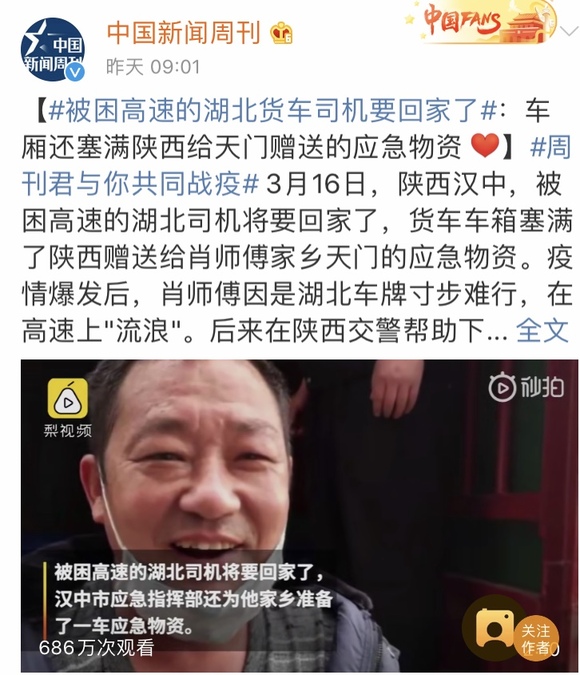
On March 16, XIAO Hongbing finally got home. The truck driver from Tianmen in Hubei Province left for Guangzhou and Guizhou on January 7 to deliver goods. As the coronavirus tightened its grip on his province, and the government in turn tightened control of people’s movement, he found himself unable to return to his family.
As he drives a Hubei-plated truck, he was not allowed to leave the highway to find accommodation and was adrift on highways in Shaanxi Province for more weeks.
Xiao found his way to a service area in Shaanxi on January 29. Exhausted, his instant noodles had almost run out and his truck was running on diesel fumes. Local traffic police helped Xiao with food and arranged a room for him. Later, he told local media that he only wanted to find a place to grab a meal and take a nap during his endless, aimless voyage around China’s highways.
Xiao was not alone in this regulatory and procedural limbo. According to a report by the Transfar Foundation, 25 percent of drivers surveyed delivered goods as usual as the epidemic expanded, and many faced the same problem.
Though Xiao’s story brought the drivers home to the Chinese people, the daily hardships of China’s 30 million truckers are overshadowed by a certain amount of jingoistic pride in the resounding success of the logistics industry as a whole.
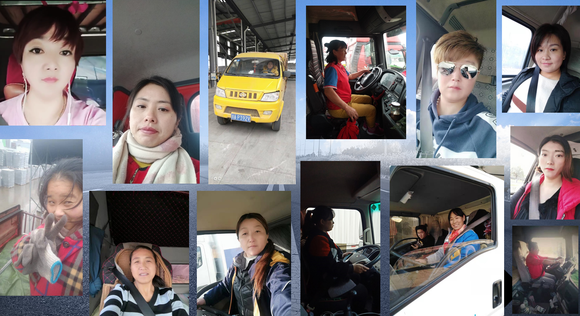
Transfar started surveying truck drivers in 2017. Their findings describe how these drivers – overwhelmingly male – lead nomadic lives behind the wheel, but also uncover a vast invisible army of female labor which goes almost unnoticed in the “masculine” road freight industry. Wives regularly accompany their husbands along the way, but their efforts to support the business are often belittled or thought of as nothing more than wifely duty: laundry and cooking. Female drivers, only 5 percent of truckers, are treated as second-class workers with their experience and capacity all but overlooked.
Jiemian News interviewed Transfar’s MA Dan on the role of truck drivers in the era of COVID-19, their relatively weak position in society, and the marginalization of women in a man’s industry.
Drivers have plenty of stories to tell, yet those the public hear are often simplified, or even reflect badly on the drivers. Public opinion tends to treat kindnesses by truck drivers as isolated, anomalous incidents and magnifies the negative traits of a small number of them to describe the whole group. The (male) drivers are not entirely innocent victims of this bias, as they themselves adopt a similar attitude to the female members of their tribe.
In Ma’s opinion, female truck drivers provide a positive gender-neutral experience for women trying to break the chains of discrimination. On the other hand, the self-marginalization of “truck wives” harkens back to feudal times.
Jiemian News: According to your report, 20 percent of truck drivers who worked during the virus outbreak were delivering medical supplies, and almost a third of them got their cargo through charity organizations or truck driver alliances. Can you tell us more about these alliances?
Ma: There is little uniformity in terms of truck drivers’ contracts, and our research focused on self-employed drivers, the largest group. Driver clubs, or alliances, tend to be confederations of the self-employed.
Self-employed truckers are always on the move. They are outsiders who make their trucks their homes. Some may work on a designated route, but most are always off somewhere new. Accidents happen and the drivers often only have to rely on their wits. At an unfamiliar town or service station, they are often ripped off for repairs and there is no guarantee of quality, so they spontaneously formed clubs or alliances to help each other out.
Jiemian News: You describe these “organizations,” often nothing more than WeChat groups, as “virtual unity.” Compared with other industrial organizations, how does this work for the drivers?
Ma: “Virtual unity” is everywhere, even among my colleagues and I. Technology means anyone working in a loosely organized environment can easily set up such support groups. What makes the case of the drivers special is that “virtual unity” is their most important connection.
Always on the road, they don’t have face-to-face opportunities like factory workers, for instance. The internet is their only way. They don’t see “virtual unity” as virtual at all. Their connections through technology allow them to communicate with one another in the real world, regardless of where they are. There is great power in such unity.
Jiemian News: Your report paints a picture of quaking drivers at the mercy of evil freight depots who take advantage of policies favourable to drivers to squeeze down costs. Just how weak is the drivers’ position?
Ma: We must remember that there are many different contracts among the drivers. Self-employed drivers work for themselves. More often than not, they are in debt after buying the rig. Others work for truck owners rather than transit companies, and their problems are similar to those faced by self-employed drivers. These drivers are in what we call a “weak” market position.
But while it is a relatively weak group, it is also quite an enviable one. Most of them are rural men in their prime of life. They choose to drive trucks because they like it. Compared with other people from their hometowns, they have high incomes and flexible schedules. People are jealous of you if you have a job which allows you to both explore the country and provides you with adequate income. So, the “weak” is not the driver’s financial status, but his position in the market. Self-employed drivers only have access to lower-end, private businesses; a shrinking market segment. Highly organized freight platforms have made the competition even fiercer, pushing the independent drivers’ earning potential further and further down.
In our survey, 60 percent of the drivers considered themselves “lower class.” Self-employed drivers are highly susceptible to risk and often find themselves helpless in the face of fraud, corruption and theft. They also have to be highly deferential to law enforcers, depot workers and freight agents. It’s a lot of emotional labor, and exhausting.
Furthermore, public opinion is formed from news reports, so when people talk about truckers, they are often focused on horrible accidents on the highways. I’m not saying this is all wrong, but these are just ordinary workers who make a valuable contribution to society and deserve the same respect as any other worker.
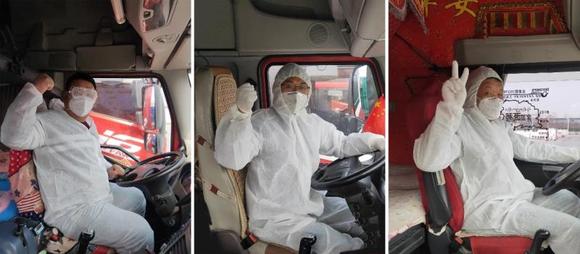
Jiemian News: We have seen plenty of recent reports praising truck drivers who worked through the coronavirus epidemic. If truck drivers have been invisible for so long, why do you think they are coming to the fore now?
Ma: As someone who studies drivers, I think it is good that there are reports on their work during the epidemic, whether as individuals or groups. It’s a good start. For mainstream media and the public, the story is usually about faster logistics and delivery, and rarely about the actual people who made all this possible.
It is another aspect of their weak market position. A paper on subway workers in America suggested that whenever a female worker performed well at work, her male colleagues and managers would consider it unusual or extraordinary. Good performance was not considered a characteristic of females, but an exception by special individuals. But when a woman made a mistake, people took it as general evidence against all female workers. I think truck drivers face a similar phenomenon. Being in a weak position, good qualities are treated as isolated cases while the negative side quickly becomes a stereotype.
The driver clubs and alliances are quite energetic, but all the fascinating stories drivers have to tell remain exclusively within their own social circle. The public has no access to them. Our research is, in a way, an attempt to let their stories be heard by a wider audience.
Jiemian News: In your report, you talk a lot about the distress truck wives face on the road, such as being unable to have pregnancy check-ups and the need to take their new-born babies along on the ride. These kinds of problems are faced by everyone, so why did you specifically focus on women?
Ma: In my first year of research, most of my interviewees were men. As a young woman, I found it hard to discuss some topics. How often and where do drivers stop to answer a call of nature? There is a lot of interesting research on gender issues between researchers and interviewees. It is an area that requires much more study.
I came across the idea of “physical discipline” by accident. While talking with truck women, I noticed that no matter how long our conversations went on, they never drank anything. Eventually, one of them told me she couldn’t drink because then she would have to find a toilet on the highway. I realized there might be additional physical discipline required by women at work and added some more questions to later surveys.
Physical discipline is a necessity for all truck drivers, men and women alike. One woman told me that you had to drive no matter whether you were a man or a woman, and when problems will occur, you had to fix them. Cargo owners are not interested in your gender.
People have different expectations for men and women. The most important quality for men is their physical capacity to handle the job. Women have to be physically able to do the job, but also to retain their traditional femininity.
I interviewed a wife in Hangzhou who had just come back from Gansu Province with her husband. She told me she hadn’t showered for days and during the whole interview, she was agitated about it. It was easy to see that women have different concerns to men, so the harshness of the situation is different for men and women.
Men can simply pull over and pee whenever they want, but women can’t. All the women I interviewed told me they would wait until they found a service station with a proper restroom, even though stopping at a service station is a waste of time and fuel.
For the wives, the physical discipline is harder to identify. They seem to merely support their husbands, but they have often experienced all the troubles that a woman could in this business. Women have periods and get pregnant, which puts them under even more pressure at work. A woman told me that truck companies don’t want female drivers because they reckon periods interfere with the job.
“Of course I have periods, but I drive day and night, even when I’m having one,” she told me. “I don’t have any problem.”
Jiemian News: You mentioned a truck wife Huilan, who had plenty of experience and knew where to find good deals, but she referred to herself as “just someone who did laundry and cooked for her husband.” What can be said about such self-marginalization?
Ma: Truck wives bear a lot of pressure. They appear to be, or are supposed to be, supporters of their husbands, based on the bias that “men go out to work and women stay at home.” This self-marginalization is sometimes a strategy to support a husband’s masculinity and role as breadwinner.
Take Huilan, for instance. She had spent more than 10 years on the road and most business negotiations were conducted by her. In first negotiations, clients often told her to call her husband, because she was not the driver. Negotiation is done by men, and a driver’s wife looking after business crossed a gender border.
Stigmatization is to be expected after crossing that kind of border, but not necessarily of the border crosser. People started teasing her husband and talking behind their backs. They said that she “denigrated the authority of her husband.” She tried to help other truck wives to find business for their men, but without much success.
I know Huilan well. She treads a very fine line. She has the capacity and energy to do the job, but whenever she makes a decision, she has to think of the consequences for her or her husband. She is constantly examining herself as she tries not to cross the border, while supporting her husband as best she can. Sometimes Huilan finds a good deal, but lets her husband make the final decision.
When a woman enters a male-dominated workplace, she is subsumed by stereotypes and generalizations and, as a result, is encapsulated in a stereotypical gender role. Self-marginalization swiftly follows.
Many wives are as good as their husbands at driving, but still tend to think their main job is washing dishes and clothes, or at least to emphasize these chores when talking.
Jiemian News: How do women drivers rate their own performance?
Ma: Most female truck drivers gave themselves a lot of credit when we interviewed them. They are a special group among drivers. Unfamiliar male drivers frequently mistook them for truck wives, but female drivers often get some privileges at loading goods or attending gatherings in the driver community.
Ending gender discrimination is not simply about switching sides, replacing female workers with male or the other way around. It requires removal of the repeatedly reinforced significance of gender differences.
While gender is rooted in drivers’ lives and work, they don’t realize it when they sit behind the wheel. Trucks, goods, and roads don’t care whether the driver is a man or woman, but discrimination requires women to make more effort. The women need a flexible strategy to deconstruct the masculinity hegemony.
Women don’t simply choose one stereotypical gender role but play different roles in different circumstances. What female truckers do – turning gender disadvantages into advantages – is a way for them to do a better job, which should lead to greater success. Female success is the antidote to gender discrimination.
We want to free people from the duality of “maintaining tradition” or “breaking with tradition.” The so-called “advantaged and disadvantaged,” “the weak and the strong,” are the two side of the same coin. Gender integration is a lofty and complicated idea, not simply a slogan. The process is not a consistent march toward a specified destination. Integration should not be limited to a certain or community. It should include everyone.
We need to integrate on the individual level as well as the social and cultural levels. While we acknowledge the differences between genders and the restrictions those differences bring, we must also reflect on each restriction and interaction. Only through honest reflection will we reach gender equality in the workplace.