Aptiv and Bosch are adapting automotive technology for robots, supplying components while testing the machines in their own factories.

A robot at work at Aptiv's booth at CIIE 2026. Photo by Zhou Shuqi
by ZHOU Shuqi, WANG Zhen
At Aptiv's booth at the China International Import Expo in Shanghai, a silver-gray robot picked up two components, aligned them and pressed them together in less than 50 seconds. Alongside another working robot, it drew more attention than the automotive sensors and computing systems nearby.
The display reflected a shift in the company's customer base. Suppliers that have spent decades serving automakers are now pursuing robot companies, adapting their expertise in sensing, computing and manufacturing for a new market.
Aptiv signed separate agreements with Chinese robotics company TARS and Shanghai Electric at the expo. Its computing platforms and intelligent power management systems will be integrated into their robots, with initial production planned before year-end.
At the neighboring Bosch booth, a robotic fingertip demonstrated touch sensors sensitive enough to detect the brush of a feather. Pressure and motion sensors help the robot adjust its grip as it handles different objects.
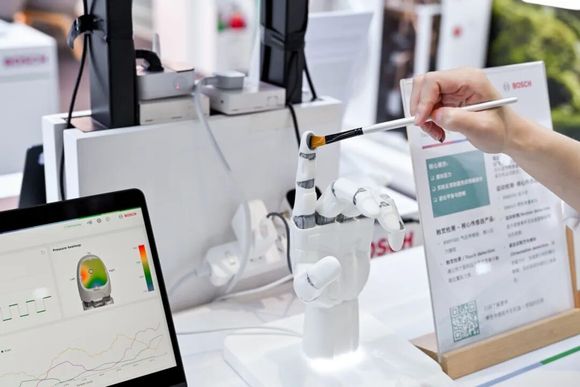
Bosch China president XU Daquan told Jiemian News that the company was working with robot makers to test their machines in its factories and assess which components and systems it could supply.
Bosch has no plans to build complete robots, Xu said. Its Chinese research team is developing robotic joints that could reach the market in 2027 if work proceeds as planned.
The expansion comes as China's auto industry faces weaker demand and falling profits. Vehicle production and sales both declined 4.5% year on year in the first nine months of 2026, according to the China Association of Automobile Manufacturers. Profits at major automotive manufacturers fell 22.8%, National Bureau of Statistics figures show.
For suppliers facing pricing pressure while continuing to invest in smarter vehicles, robotics offers another market for technology they have already spent heavily developing.
"Robots need to see and hear. More importantly, they need to make judgments," Simon Yang, Aptiv's president for China and Asia Pacific, told Jiemian News.
That resembles the way intelligent driving systems operate, he said. Robots also need computing power, controllers and electrical and electronic architectures — capabilities already established in the automotive supply chain.
Aptiv's two demonstration robots, performing visual inspection and assembly, used its robotics computing platform. ZHANG Jian, product engineering director for Aptiv's Intelligent Systems business in China, told Jiemian News that the design drew on automotive applications, including digital cockpits, with chips, interfaces and cameras adapted for robot tasks.
The technology cannot simply be transferred unchanged. Xu said vehicles and robots have different operating conditions, purposes and requirements for safety and durability.
Aptiv sees the greatest scope for reuse in underlying architectures, system integration and supply chains. Components and testing standards still need to be selected for each application.
Yang said a shared platform could help robot startups avoid developing entire control systems themselves when their early sales volumes are too small to spread the cost. Aptiv has also recruited from other industries and adjusted its project and sales teams to accommodate customers with different decision-making and development schedules.
The relationship extends beyond supplying parts.
“We are both their component supplier and their customer,” Yang said.
Hundreds of robots from TARS and Shanghai Electric are set to enter Aptiv's production lines gradually for testing and refinement. Factory data will also support product development and AI model training.
Bosch plans robot trials at about 100 to 200 workstations in China this year. It wants the machines to learn production tasks and remain useful when products and factory layouts change.
Xu cited Bosch's U-shaped production lines, where workers can turn from one station to the next and take on different tasks as production changes. Robots would need similar flexibility.
For Aptiv, the value also lies in recording production speeds, quality and equipment conditions to improve factory planning and maintenance.
"The core purpose of using robots on our production lines is to use the data they generate to improve digital manufacturing," Yang said. "The gains in efficiency and costs are far greater than those from replacing workers."
But factory trials are exposing engineering limits.
Some robots still fall short on speed, precision and heat management, Xu said. When carrying heavy objects, their joints and motors can overheat, potentially requiring a cooling break after about an hour.
Small production volumes and continued reliance on hand-built components also make consistency and long-term reliability harder to achieve.
Xu said Bosch's experience in building production lines, controlling quality and managing suppliers could help robotic components move into mass production. China's concentration of robot makers and component suppliers makes it easier to find development partners and produce prototypes quickly, he added.
Those advantages will face a practical test on factory floors, where robots must meet production targets and run reliably for a full shift.