Cheaper vehicles and advances in autonomous driving are drawing automakers, technology suppliers and logistics giants into a rapidly expanding market.

AI-generated image from Jiemian News
by ZHOU Mo
China's driverless delivery vehicle industry is attracting billions of dollars in investment as falling costs and advances in autonomous driving technology bring new competitors into a market once dominated by startups.
On October 20, Neolix announced nearly $400 million in fresh financing, less than a year after raising more than $600 million. Boyu Capital and China's National Artificial Intelligence Industry Investment Fund led the latest round, with participation from Alibaba's AEF NextGen fund, Monolith Management, GGV Capital and Temasek-backed Vertex Growth.
Founded in 2018, Neolix has now raised more than 10 billion yuan ($1.4 billion).
Its rivals are also securing major funding. Rino.ai, backed by delivery giant SF Express, recently completed a funding round that brought its Series C total to $100 million. Zelos Technology raised more than $300 million in February.
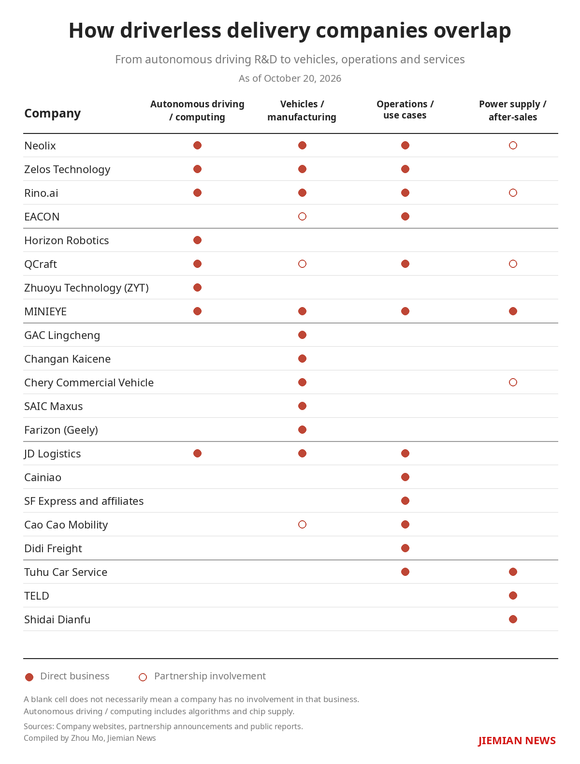
The influx comes as autonomous driving specialists Momenta, QCraft and Zhuoyu Technology (ZYT), along with automakers including Changan, Geely and Dongfeng, expand into driverless logistics.
The economics are improving. A 2021 report by EO Intelligence estimated that autonomous last-mile delivery vehicles cost 300,000 to 500,000 yuan to build. By 2025, Neolix said its costs had fallen below 100,000 yuan.
An industry professional told Jiemian News that China's mature automotive supply chain had made sensors, computing platforms and vehicle components significantly cheaper, allowing autonomous driving technology to be fitted into relatively inexpensive commercial vehicles.
Deployment is accelerating. Neolix says it now has more than 30,000 vehicles operating worldwide, with a combined autonomous driving distance exceeding 260 million kilometers. Zelos reported a fleet of more than 20,000 vehicles following its integration with Cainiao's autonomous delivery business, while Rino.ai has delivered more than 5,000.
The lower barriers to entry are reshaping competition.
Momenta is adapting autonomous driving technology developed for passenger cars to delivery vans. QCraft, meanwhile, has partnered with Chery to develop Level 4 logistics vehicles, introduced a driving solution costing less than 10,000 yuan ($1,400), and launched its Robo-X open platform.
Rather than developing vehicles, software and operations independently, companies can now specialize and form partnerships. Automakers supply vehicles, technology companies provide driving systems, and logistics operators bring customers and orders.
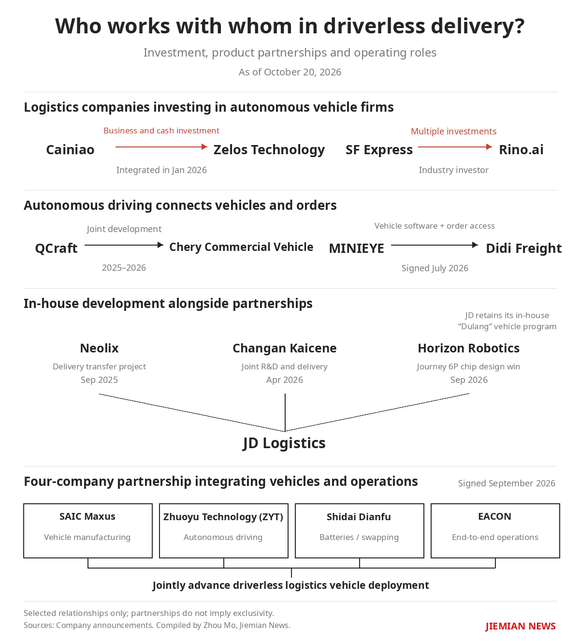
China's logistics giants are becoming increasingly influential in this emerging division of labor.
In January, Alibaba-owned Cainiao transferred its autonomous vehicle business to Zelos and invested in the startup. JD Logistics, meanwhile, is developing its own vehicles while working with partners including Changan and Horizon Robotics.
At a technology conference in September, JD reiterated plans to purchase one million autonomous vehicles over the next five years.
Other partnerships are emerging. In July, autonomous driving company MINIEYE agreed to supply vehicles and technology to Didi Freight, which would provide access to delivery orders and dispatching services.
For autonomous driving startups, this marks a shift: instead of having to find customers after developing vehicles, they increasingly face logistics companies actively seeking autonomous solutions.
But replacing drivers remains only part of the challenge. Delivery workers also load, unload and hand over goods — tasks that today's autonomous vehicles cannot fully handle, an industry professional told Jiemian News.
Companies are consequently experimenting with leasing, pay-per-delivery and robot-as-a-service models, rather than relying solely on vehicle sales.
As autonomous delivery expands, the competition is increasingly about more than the vehicles themselves. Companies must also decide how to divide the work of manufacturing, operating and servicing fleets — and who takes responsibility for the deliveries.