From cleaning solar panels to replacing motorcycle batteries, Chinese manufacturers are looking beyond hardware exports for new sources of revenue.

The opening phase of 140th Canton Fair concluded on October 19. Photo from CFP
by LIANG Baoxin, ZHANG Xilong
For a growing number of Chinese exporters, selling a product overseas is no longer the end of the transaction. It can be the beginning of another business.
Solar panels need cleaning. Motorcycle batteries wear out. Humanoid robots require software and services tailored to where they work.
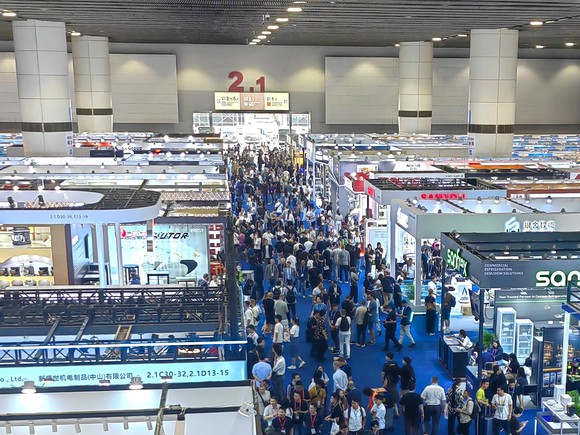
At the 140th Canton Fair, which concluded its first phase on October 19, manufacturers were pitching not just products but the businesses built around them. More than 12,000 companies participated in the opening phase of China's largest trade fair, showcasing everything from industrial machinery to renewable energy equipment.
Beijing Multifit Electrical Technology isn't selling solar panels. It is selling a way to keep them clean.
Its US$10,000 AI-powered robot can navigate solar farms, wash panels and return to a charging station. At the Canton Fair, one crawled across a tilted solar panel array as prospective buyers watched.
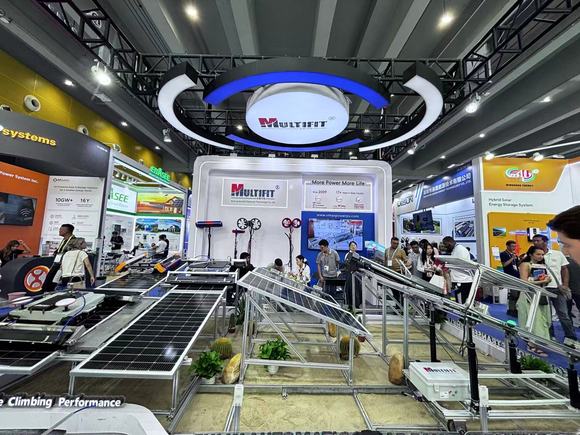
The company's products reach more than 50 countries and regions, with overseas sales accounting for about 90% of revenue. Customers range from solar farm operators to cleaning contractors and equipment distributors.
The Middle East is a particularly important market. Dust and sand accumulate on solar panels, reducing their electricity output and making regular cleaning essential.
The business was slow to take off. WANG Li, a company representative, told Jiemian News that demand was initially limited, but grew as the company refined its robots for different environments and solar installations expanded worldwide.
The growing number of installed panels now provides a market for cleaning and maintenance equipment, even when new construction slows.
At the Canton Fair, Multifit distributed about 2,000 brochures in less than three days. But Wang said orders rarely materialize on the exhibition floor. Customers typically require technical discussions and factory inspections before committing to purchases.
For Zhangzhou Huawei Power Supply Technology, the aftermarket is already the main business.
The Fujian-based manufacturer, known for its OUTDO Battery brand, supplies motorcycle batteries to nearly 180 countries and regions. About 80% of its customers are parts distributors and aftermarket service providers, rather than motorcycle manufacturers.
Motorcycle batteries typically need replacing after three to five years. OUTDO supplies replacement batteries for more than 20 million motorcycles annually, according to the company, which also claims nearly 70% of Thailand's motorcycle battery aftermarket.
The business is substantial. Motorcycle batteries account for more than 60% of OUTDO's revenue, energy storage contributes over 30%, and overseas markets generate more than 70% of total sales.
Exports from its Chinese factories rose more than 20% in the first nine months of 2026, according to vice-president CHEN Xiaofeng.
OUTDO has manufacturing facilities in Fujian, Thailand and Malaysia. It has also expanded beyond conventional lead-acid batteries into sodium-ion technology.
Chen said the growing international profile of Chinese motorcycle brands, including CFMoto and ZXMOTO, had helped draw attention to domestic component suppliers. Overseas buyers who once favored suppliers associated with Japanese manufacturers were increasingly considering Chinese alternatives.
But price competition remains fierce. Chen told Jiemian News that while customers focus on price, delivery and quality, cheaper batteries can become costly if they generate complaints and warranty claims.
The company has also sought greater visibility through motorsport, beginning a technical partnership with a BMW Motorrad racing team in 2024.
For Guangzhou-based AutoLife Robotics, the challenge is different: finding customers for a technology whose commercial uses are still evolving.
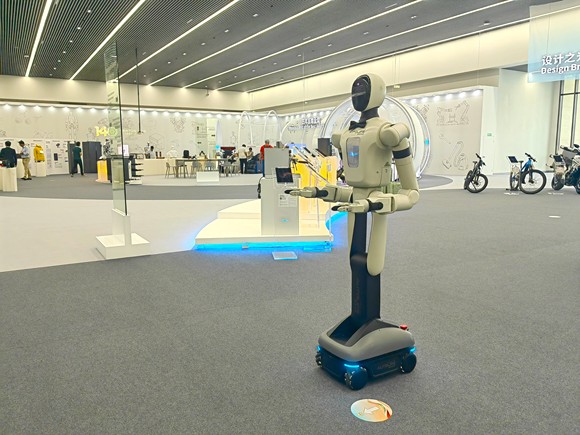
At the Canton Fair, a wheeled humanoid robot greeted visitors in English, drawing interest from overseas buyers. Among them was Rocha, a Portuguese representative of a Spanish trading company whose group operates 2,000 to 3,000 retail stores worldwide. He told Jiemian News that the group was exploring the use of humanoid robots in its stores, including AutoLife's modular systems for selling coffee, drinks and snacks.
Such inquiries have become more common as buyers move beyond curiosity about what robots can do.
YE Zhipeng, AutoLife's marketing director, estimated that only about 20% of visitors to the Canton Fair's first dedicated service robot section in 2025 had specific purchasing requirements. By the fair's 139th edition, that figure had risen to roughly 70% to 80%.
Buyers now arrive with details about their buildings, labor costs and operating needs, he told Jiemian News.
That creates opportunities but also complicates sales. Unlike robots built for a single task, general-purpose humanoid robots often need software development, testing and customization for each customer.
AutoLife recently supplied a robotic guide for Hong Kong's Wong Tai Sin Temple, developing a system that provides visitor information and automated commentary. Ye said the project could lead to further joint development.
The company is now seeking a larger presence at trade shows, including next year's Canton Fair, the World Robot Conference and the World Artificial Intelligence Conference.