With a new opera house and a major restructuring of state-owned arts organizations, Shanghai wants to move beyond hosting international productions to creating original works that can reach audiences worldwide.

Soar Theatre at the Shanghai Grand Opera House. Photo from Shanghai Grand Opera House
by CUI Yixing
Before the Shanghai Grand Opera House opened on October 17, technical teams from Venice's Teatro La Fenice, the Mariinsky Theatre in St. Petersburg and Berlin State Opera had already visited the venue. Their attention was drawn not only to its seating capacity but also to its six-section stage system, designed to accommodate multiple large-scale productions.
The logistical demands of international opera are substantial. A production of Tosca requires about eight shipping containers of scenery and equipment, while Aida needs more than 20 container trucks. At the new venue, one production can be performed while another is being assembled on a separate stage platform.
For ZHANG Xiaoding, general manager of both the Shanghai Grand Opera House and the Shanghai Grand Theatre, the new facility builds on nearly three decades of experience.
Her team has brought a technical archive containing more than 10,000 production templates from the older theater, covering stage dimensions, equipment requirements and installation procedures.
"We have one team working on two fronts," Zhang told Jiemian News on October 15, as preparations for the opening season continued.
The opening marked a significant moment for Shanghai's performing arts industry. On the same day, the 25th China Shanghai International Arts Festival began, while the newly established Shanghai Performing Arts Group was officially inaugurated.

Shanghai already has China's largest commercial performance market. In 2025, the city hosted 61,400 commercial performances, generating 5.85 billion yuan ($822 million) in ticket sales, ranking first among Chinese cities in both measures.
But the city's next challenge goes beyond building theaters and attracting international productions: it wants to develop more original works capable of sustaining repeat performances, touring internationally and becoming part of other companies' repertoires.
The newly established Shanghai Performing Arts Group is intended to bring together the city's major state-owned performing arts organizations and 25 theaters and performance venues.
Shanghai has 18 municipal-level state-owned performing arts companies, spanning drama, ballet, dance, traditional Chinese opera and orchestral music. Most have operated under separate administrative structures, with their own production schedules, audiences and distribution channels.
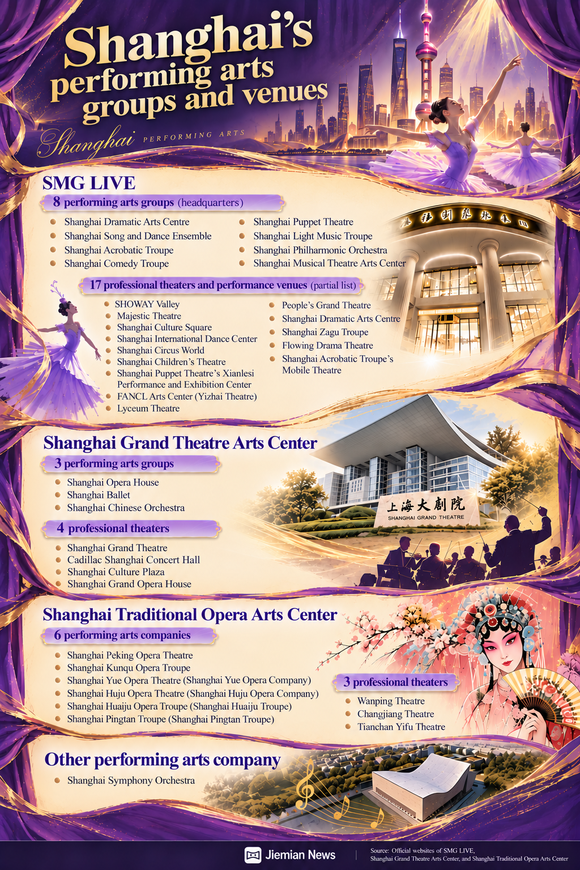
The restructuring aims to coordinate these resources more effectively, from developing scripts and financing productions to scheduling performances, marketing and international touring.
The challenge is particularly evident in musical theater.
This summer, the original Cantonese-language musical The Impossible Trial, produced in Hong Kong, staged 20 performances at Shanghai Culture Square. Every ticket sold out on the day sales opened.
For FEI Yuanhong, general manager of Shanghai Culture Square, its success raised a question: what would happen if Shanghai could produce 10 original musicals with similar appeal?
The venue has been working toward that goal for several years. In 2019, it launched an incubation program for original Chinese-language musicals, providing early-stage funding and mentorship before connecting promising projects with professional producers.
Under the arrangement, production companies take responsibility for casting, budgets, rehearsals and premieres, while the venue helps manage intellectual property rights and royalty arrangements.
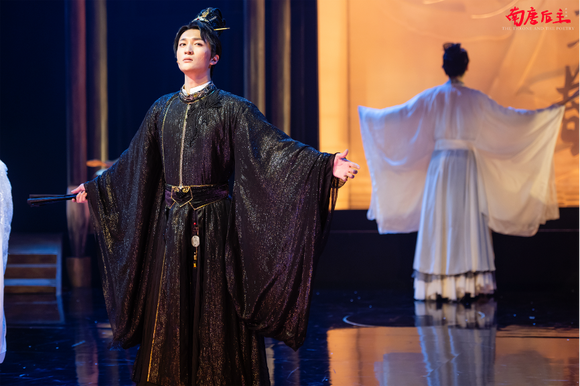
One beneficiary was young playwright SUN Haocheng, whose first application was rejected. He returned the following year with Smash the Wall, which was accepted. Sun has since contributed to more than 10 musicals, including The Throne and the Poetry and Yang Jian: The God of War.
Fei hopes the new group will make it easier for artistic companies and producers to collaborate, reducing the financial risks associated with developing original productions.
CAO Yixia, a researcher at the Institute of Applied Economics at the Shanghai Academy of Social Sciences, told Jiemian News that support should begin earlier, at the script development and project evaluation stages.
The restructuring's success, she argued, would depend on whether creative resources, theater schedules and touring networks could be coordinated around individual productions.
Getting a new production onto the stage is only the beginning. To become commercially sustainable, it needs repeat performances and opportunities to reach new audiences.
"Good works that become widely known are not only written; they are also shaped through performance," WANG Siyu, deputy director of the Shanghai Symphony Orchestra, said.
He cited Chinese Kitchen: A Feast of Flavors, an original orchestral work by composer LIANG Haoyi inspired by Chinese cuisine.
During its development, Wang accompanied the composer to the kitchens of Shanghai's Jinjiang Hotel, where they observed chefs preparing dishes and sampled the food. The resulting composition features 10 movements representing 10 dishes.
The hotel subsequently introduced dishes corresponding to the music, offering audiences another way to engage with contemporary orchestral work.
The composition has since been performed repeatedly, both in full and through individual movements incorporated into other concerts. According to Wang, it has also been performed by orchestras including the New York Philharmonic, Guangzhou Symphony Orchestra and China Philharmonic Orchestra.
An Australian youth orchestra has expressed interest in adding it to its repertoire.
Such arrangements allow original compositions to travel without requiring the original performing ensemble to accompany them, expanding their potential reach.
The Shanghai Grand Opera House is also positioning itself as a platform for local productions.
Its inaugural season features 47 productions across 82 performances, alongside more than 100 arts education activities. All 18 municipal-level state-owned performing arts companies are represented.
The venue's 1,200-seat Soar Theatre will serve as a premiere space for local theater, dance and traditional Chinese opera.
Zhang said artistic companies had already approached the venue with proposals, and the opera house planned to participate in selected projects from the early stages of development.
More original productions will also require a better understanding of who is buying tickets.
At Shanghai Culture Square, the average audience member was 31 years old in 2025. Fei has observed that younger theatergoers are increasingly attentive to casting, seating, ticket prices and the overall experience.
The venue has accumulated 850,000 members over 15 years, who account for roughly 90% of its box-office revenue.
Fei believes theaters within the new group should maintain distinct programming identities rather than compete for the same productions and audiences.
Culture Square, for example, specializes in musical theater, while the Shanghai Concert Hall, Shanghai Grand Theatre and Shanghai Grand Opera House can develop programming suited to their respective facilities and audiences.
Cao proposed a management model under which individual theaters retain control over programming, while sharing ticketing, marketing and audience data services. Procurement and administrative functions could be coordinated centrally.
The approach could help producers determine where to stage a work, how many performances to schedule and which audiences to target.
Long-running productions, however, need to attract visitors from beyond Shanghai.
ZHAO Chenlin, vice-president of Shanghai Media Group's performing arts business, estimated that a long-running production requires between 100,000 and 300,000 audience visits annually, making it difficult to rely exclusively on local theatergoers.
Partnerships with travel platforms, commercial venues and tourism organizations could help make attending performances part of a visit to Shanghai.
The new group's longer-term ambition is to strengthen the international presence of Shanghai-produced performing arts.
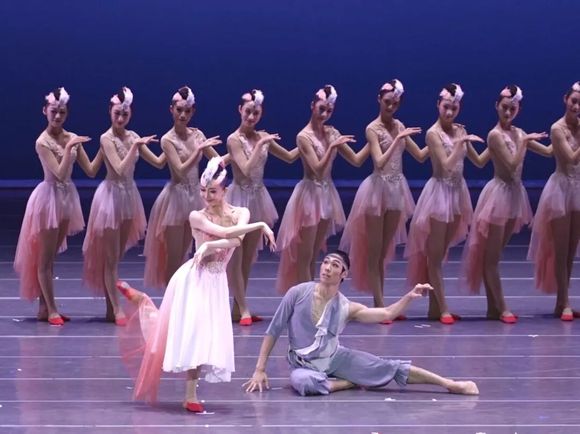
The Shanghai Dance Theatre's original dance drama Crested Ibises toured Japan last year, staging 55 performances over 66 days and attracting more than 80,000 spectators, according to the company.
Unlike orchestral compositions that can be performed by overseas ensembles, the dance production traveled with its original cast and technical team, requiring extensive coordination with local venues.
Another model is international co-commissioning.
The Shanghai Symphony Orchestra and New York Philharmonic jointly commissioned the oratorio Shanghai! Shanghai!, which has subsequently been performed by ensembles in Shanghai, New York, Hong Kong, Britain and Germany.
These approaches involve different arrangements for copyright, production, logistics and artistic collaboration.
Shanghai already has an international network on which to build. Over 25 editions, the China Shanghai International Arts Festival has brought together nearly 20,000 artists, institutional representatives and industry professionals from more than 80 countries and regions.
Its international performing arts marketplace this year plans to feature 30 video presentations and 15 live project showcases, offering opportunities for producers to connect with overseas presenters and institutions.
The city's 2026 cultural trade action plan also calls for joint productions between Chinese performing arts organizations and international producers, supported by a one-stop public service platform providing market information, legal assistance and other services.
Cao believes overseas partners should become involved earlier in the creative process, rather than being approached only after a production premieres. International co-commissioning and development partnerships could help Shanghai-made works secure overseas performances from the outset.
The city's ambitions are not entirely new.
In 1965, composer LÜ Qiming's orchestral work Ode to the Red Flag premiered at the Shanghai Spring International Music Festival. Over the following six decades, repeated performances by different orchestras helped establish it as one of China's best-known orchestral compositions.
On October 17, the same work was chosen to open the inaugural concert at the Shanghai Grand Opera House.
The choice offered a reminder of what Shanghai's performing arts industry is trying to achieve: creating works that can outlast their premieres, find audiences across generations and eventually become part of the international repertoire.
For the newly established Shanghai Performing Arts Group, the challenge is to turn the city's considerable theatrical infrastructure and artistic resources into a sustained pipeline of original productions.