At Shanghai's annual business advisory meeting, executives from Nike, Adidas, Bain and other global firms called for better urban experiences, stronger consumer spending and wider AI adoption.

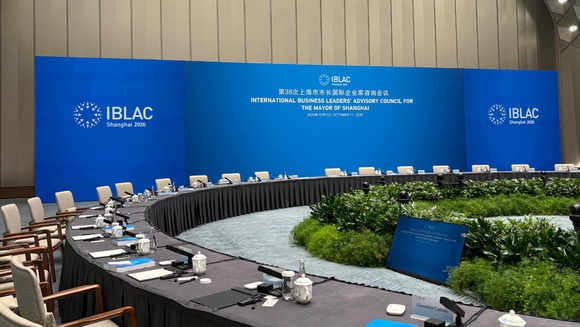
The 38th International Business Leaders' Advisory Council for the Mayor of Shanghai (IBLAC) meets in
by SUN Jingzhi
Global business leaders have urged Shanghai to tap opportunities in healthcare, tourism, sports and artificial intelligence to drive growth in its services sector, which accounts for about 80% of the city's GDP.
The proposals were made on Sunday, October 11, at the 38th International Business Leaders' Advisory Council for the Mayor of Shanghai (IBLAC), an annual forum that advises the city on its economic development.
Shanghai Mayor Zhu Zhongming highlighted the importance of the services sector at the meeting, saying it accounts for roughly 80% of the city's GDP, contributes more than 80% of its economic growth and fiscal revenue, and employs nearly 80% of its workforce.
Zhu outlined plans to encourage innovation in services, advance reforms and further open up the sector. Priorities include closer integration of retail, tourism, culture, sports and exhibitions, as well as improved healthcare and education services.
Manny Maceda, chair of Bain & Company, recommended a two-pronged approach: improving essential services such as healthcare, senior care and housing while developing more experience-driven offerings in tourism, shopping, culture and entertainment.
He identified China's growing silver economy as an opportunity for Shanghai, suggesting the city develop medical tourism, senior-friendly shopping centers and recreational activities tailored to older consumers.
Maceda also urged Shanghai to rethink how it promotes tourism. Rather than relying primarily on individual attractions, the city could build a stronger international identity around distinctive experiences, including its food culture.
Merlin Swire, chief executive of John Swire & Sons, similarly emphasized the importance of making urban spaces more attractive to visitors.
He said effective placemaking could draw more visitors, encourage them to stay longer and increase spending. He proposed a citywide coordination mechanism supported by an expert advisory panel.
Swire also suggested piloting commercial and cultural improvement districts, bringing together local authorities, businesses and cultural institutions to revitalize public markets, organize events and build neighborhood brands.
Nike president and CEO Elliott Hill suggested Shanghai make better use of its major sporting events to drive spending beyond stadiums and racecourses.
Events such as the Shanghai Marathon, Formula 1 Chinese Grand Prix and Shanghai Masters tennis tournament could anchor broader programs of shopping, cultural activities, exhibitions and entertainment, he said.
Adidas CEO Bjørn Gulden pointed to the popularity of Jiangsu's provincial football league, nicknamed the "Su Super League," as an example of how sporting events can engage fans and generate consumer spending.
He suggested Shanghai build on that enthusiasm to strengthen its appeal as an international sports and lifestyle destination.
Artificial intelligence was another focus of the discussions, with Goldman Sachs president and chief operating officer John Waldron highlighting the potential of an AI-driven wave of technological investment and adoption to support Shanghai's services sector.
Harvard University professor Jason Furman offered two specific proposals.
He suggested testing AI-assisted medical documentation in Shanghai's public hospitals, measuring success by how much time doctors save and whether patients report greater satisfaction.
Furman also argued that Shanghai was well positioned to establish a regulatory sandbox for generative AI in finance and should encourage wider adoption of the technology across the sector.
The recommendations come as Shanghai seeks to improve the productivity and competitiveness of its services sector while making the city more attractive to residents and international visitors.