As Chinese heavy equipment expands overseas, WorldSkills offers a timely look at the technicians, training and new skills needed to keep it running.

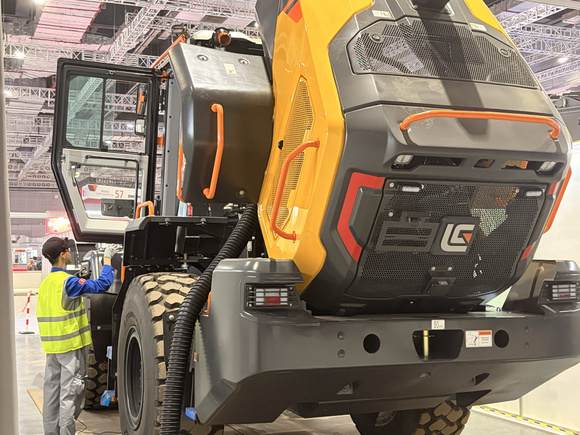
The Heavy Vehicle Technology competition at the 48th WorldSkills Competition. Photo by Zhou Shuqi
by ZHOU Shuqi, ZHANG Anqi
Before the competition began, ZHOU Le did not know what machine he would be asked to repair.
At the Heavy Vehicle Technology contest at the 48th WorldSkills Competition in Shanghai, several large machines remained hidden behind curtains until competition day. Zhou, a student at Ningbo Technician College representing China, would have 18 hours to diagnose and repair faults across six areas, including diesel engines, hydraulics, electrical systems, transmissions, steering, brakes and chassis.
The machine could be an excavator, road roller, truck, tractor or dumper. Competitors are given repair manuals running to thousands of pages in English and must submit their final reports in English.
The challenge reflects a growing reality outside the arena.
As more Chinese-made heavy equipment enters mines, ports and construction sites overseas, manufacturers need technicians who can keep those machines running — often far from headquarters, working with unfamiliar models and local service teams.
One of Zhou's former schoolmates, TANG Qiwen, is preparing to move to Indonesia after graduating. Tang did not make China's national WorldSkills training squad, but his second-place finish in a provincial skills competition attracted the attention of Chinese machinery maker LiuGong.
He will join the company's overseas business unit in a technical support role, earning more than 200,000 yuan (US$28,000) a year.
In Indonesia, Tang will act as a link between LiuGong's headquarters and local technicians, passing on technical documents, troubleshooting advice and parts information, while helping explain how equipment should be operated and repaired.
Zhou will solve an unfamiliar machine fault in competition. Tang will be expected to do much the same in an overseas market.
The need is growing as Chinese equipment exports expand. China exported construction machinery worth 430.4 billion yuan in 2025, up 14.5% from a year earlier. Heavy-truck exports reached about 340,000 units, according to the China Association of Automobile Manufacturers.
For major manufacturers, overseas markets already account for a large share of revenue. LiuGong generated nearly 15.8 billion yuan overseas in 2025, or 47.65% of its total revenue.
That expansion has increased demand for after-sales service.
LiuGong's global service training director HUANG Guangzhou told Jiemian News that the company's demand for overseas maintenance personnel rose by 1.5 to two times in 2024 and had increased to roughly three times the previous level by 2026. The company estimates it needs an overseas service team of 800 to 1,000 people.
Ningbo Technician College teacher Gao Ji, also a coach for China's national training team, has seen the same trend. LiuGong hired one competition-trained student from the college previously and increased that to three this year. Gao said future demand could reach around 20.
The college is now working with LiuGong on targeted training for senior students, including language study, company-taught courses and internships.
But overseas servicing requires more than mechanical ability.
Technicians must understand technical English, local regulations and safety standards, and equipment specifications that can differ by market. LiuGong also provides cultural and legal training before sending staff abroad, Huang said.
The machines themselves are changing too.
Maintenance once centered on engines, hydraulics and transmissions. Now electric heavy trucks are moving into commercial use, adding batteries, controllers and high-voltage systems to the technician's workload.
Sales of new-energy heavy trucks exceeded 230,000 units in China in 2025, with market penetration above 28%, according to compulsory insurance registration data.
That means technicians increasingly need to diagnose whether a fault lies in a mechanical component, a control system, a sensor or communications between systems.
At the same time, older diesel-powered equipment will remain in service for years. Huang said LiuGong increasingly wants technicians with electrical, battery and intelligent-maintenance skills, estimating that the industry already faces a roughly 50% shortage in these areas.
That shift is also changing the market value of skilled workers.
Huang said LiuGong directly recruits strong performers from WorldSkills and national skills competitions. Some can enter the company’s expert talent pool through accelerated channels, with senior specialist roles paying several hundred thousand yuan a year.
Training institutions are adapting in response. Ningbo Technician College has bought two electric excavators, trained teachers in high-voltage systems and is preparing to add new-energy equipment to its curriculum.
For Gao, the key skill is not familiarity with any single machine. Technicians will encounter far more equipment during their careers than they can ever study in school.
What companies value, he said, is whether someone can find the right information, make a judgment and solve a problem when facing unfamiliar equipment.
WorldSkills compresses that uncertainty into an 18-hour competition.
For Chinese manufacturers expanding overseas, however, it is becoming part of everyday business.