The competition gives Shanghai an opportunity to introduce new occupations and standards, strengthen training capacity and forge closer links between vocational education and industry.

Photo from CFP
by XIE Lingning
The 48th WorldSkills Competition opens in Shanghai on September 22, putting the city at the center of one of the world's largest showcases of vocational skills.
For Shanghai, however, hosting the biennial competition is about more than medals. The city is seeking to use the event to bring international skills standards into its vocational education and training system, while connecting training more closely with the changing needs of employers.
That comes as China's labor market is undergoing structural shifts. Fast-growing industries including advanced manufacturing, artificial intelligence, green energy and healthcare need workers able to adapt quickly to technological change. At the same time, the country's mature vocational education system is under pressure to align more closely with actual jobs, technical standards and career progression.
Shanghai officials have described their approach as bringing WorldSkills standards "in and down to the ground" — incorporating competition standards, training methods and assessment systems into vocational education and lifelong skills training.
One example is the development of courses in areas such as AI data annotation and model applications. Shanghai officials said the city has been comparing industry requirements with WorldSkills standards and designing training programs around what employers actually need.
The approach also reflects a broader shift in Chinese skills policy toward giving companies a larger role in training and assessment. The Ministry of Human Resources and Social Security has encouraged leading companies, suppliers and vocational schools to jointly build training systems that integrate education, workplace needs and skills assessment.
Shanghai's case is particularly relevant because its economy spans advanced manufacturing, software and AI, international logistics, rail transport, emerging aviation industries and a large modern services sector.
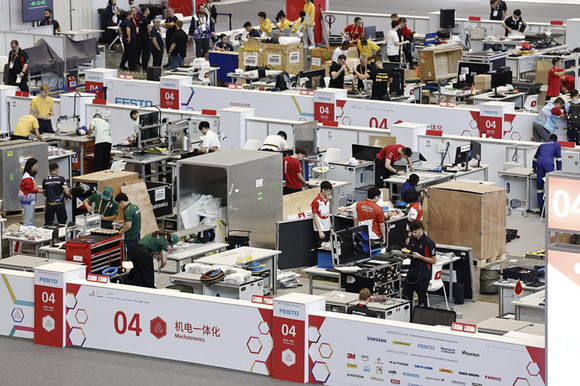
WorldSkills Shanghai 2026 features 64 skills, the first time the competition has exceeded 60. Seven are new: Dental Prosthetics, Digital Media Interactive Design, Intelligent Security Technology, Rail Vehicle Technology, Retail Sales, Software Testing and Unmanned Aerial Systems.
The additions illustrate how the definition of skilled work is expanding alongside technological and industrial change.
Unmanned Aerial Systems, for example, covers the design, assembly, testing and maintenance of drones for applications ranging from surveying to agriculture and logistics. Rail Vehicle Technology addresses skills needed as urban and intercity rail systems expand.
Software Testing and Intelligent Security Technology, meanwhile, fit closely with Shanghai's push into software, AI and digital services. Under the city's latest industry plan, Shanghai aims to increase the scale of its software and information services industry from 2.1 trillion yuan in 2025 to 4 trillion yuan by 2030.
The skills represented at WorldSkills also extend well beyond the traditional image of blue-collar work. Health and Social Care, Dental Prosthetics and other service-oriented competitions reflect growing demand for skilled workers in healthcare, consumer services and other urban industries.
That broader definition is central to the longer-term value Shanghai hopes to draw from the competition.
By putting occupations that often receive limited public attention on an international stage, WorldSkills gives young people a clearer view of technical careers as routes to professional development, international exchange and higher-skilled employment.
The effect is already visible in some vocational schools.
At Shanghai Information Technology School, students at its Web Technologies training base have been using WorldSkills training exercises in regular classes, developing and debugging websites under time limits. The school has also incorporated competition standards into courses combining mechanics, electronics and programming, including its Service Robot Assembly and Maintenance program.
Shanghai has also sought to connect skills assessment more directly with employment. A municipal regulation issued in April 2024 strengthened the city's vocational skills assessment system, part of a wider effort to make recognized skill levels more relevant to recruitment, career advancement and compensation.
The aim is ultimately to create a more direct cycle between industrial demand, training and career development: companies identify the skills they need, training institutions respond, workers gain recognized qualifications and those skills are rewarded in the workplace.
If that connection can be strengthened beyond the competition itself, WorldSkills Shanghai could leave a legacy more important than the medals awarded this week — making skilled careers a more visible and viable choice for young workers navigating a rapidly changing economy.