A new wave of Chinese restaurant brands is moving into prime shopping districts abroad and targeting local diners as they accelerate their expansion.

photo from Chef Fei's official website
by MA Yue
"Ni hao, ni hao! China's King of Stir-Fry, Chef Fei's Stir-Fry Beef with Peppers, enjoy!"
Servers of different ethnicities repeat the line as they bring dishes to tables at Chef Fei's new restaurant in San Diego, a scene that customers have filmed and shared on social media.
The restaurant at Westfield UTC is the first overseas outlet for Chef Fei, a Chinese chain specializing in Hunan-style stir-fry. Located near affluent neighborhoods and a university district, the shopping center is home to department stores, luxury labels and upscale restaurants — far removed from the Chinatowns and Chinese enclaves that have traditionally anchored Chinese dining overseas.
Chef Fei told Jiemian News that its signature US dish is stir-fried beef with peppers, made with American wagyu beef, while its well-known stir-fried pork with peppers remains on the menu. During the soft opening, waits exceeded 90 minutes, and reservations for the first three weeks of September were almost fully booked, according to the company.
The opening reflects a broader shift among Chinese restaurant chains expanding overseas. A growing number of established full-service and fast-casual brands are moving beyond Chinese communities into mainstream commercial districts and seeking local customers.
Chinese casual-dining chain Green Tea Restaurant had 22 restaurants outside the Chinese mainland in the first half of 2026 and expects the number to reach 30 by year-end, with overseas revenue exceeding 400 million yuan. TAI ER, a Sichuan restaurant chain specializing in suancai fish, had 35 overseas outlets, mainly in Southeast Asia and North America.
Lausanjee, the overseas brand of Chinese fast-casual chicken chain Laoxiangji, opened its first overseas restaurant in Kuala Lumpur in April and later formed a joint venture with Singapore's JUMBO Group to develop the Singapore market.
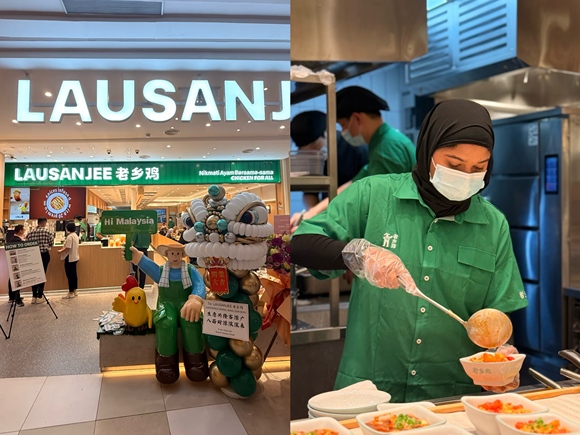
One of the clearest changes is location. Rather than clustering around Chinatowns, Chinese chains are increasingly seeking sites in major shopping districts.
Westfield UTC, for example, is home to Nordstrom and Macy's as well as luxury brands including Hermès, Chanel and Bulgari. Chef Fei told Jiemian News that it hopes to use San Diego as a starting point for broader US expansion after following a similar path in China, where it grew from its home market of Changsha into major cities.
In Singapore, Orchard Road has also become a popular destination for Chinese restaurant brands. Industry data cited in the Chinese source showed that the number of Chinese restaurant brands in the city-state rose from 32 in June 2024 to 85 in August 2025, while their combined store count more than doubled.
The chains are also trying to move beyond the perception of Chinese food overseas as a low-cost option.
Chef Fei's stir-fried beef with peppers is priced at US$32.79 in San Diego, according to its US website. Rather than simply moving upmarket, the chain is seeking to reproduce a business model developed in China while gaining more pricing power among local consumers.
Their customer base is changing as well. YANG Guofu, founder of YGF Malatang, previously told Jiemian News that non-Chinese diners accounted for more than half of customers at its European restaurants. Average monthly sales reached €130,000 to €140,000 per store, with the best-performing outlet exceeding €200,000.
Localization remains necessary. YGF Malatang has introduced tom yum and curry soup bases in Europe, while Chef Fei has made beef with peppers and broccoli its flagship US dish. Lausanjee removed pork and lard from its Malaysian menu and added dishes and drinks suited to the local market.
Talent is another challenge. Chef Fei has offered annual salaries of about US$130,000 to US$160,000 for restaurant managers in the US and around US$130,000 for executive chefs.
A recruitment team working for the company told Jiemian News that its San Diego kitchen team numbers in the dozens and that it has sought locally based cooks with experience in Hunan or Sichuan cuisine and high-heat wok cooking.
For restaurant chains, however, opening successful individual stores is different from building a scalable overseas business. Full-service and fast-casual restaurants depend heavily on chefs, ingredients and local supply chains, while religious practices and import regulations vary between markets.
"Organization and talent are among the core challenges of overseas expansion, and are no less important than the supply chain," SHANG Wei, chief financial officer of Green Tea Group, told Jiemian News.
Green Tea initially sends experienced employees from China to fill core positions when entering a new market, before gradually developing local managers, chefs and service teams, Shang said.
"An overseas business cannot rely solely on employees dispatched from China. It has to develop the ability to build and sustain a local team," he said. "Only when the local team matures can the overseas model be replicated sustainably."