The flagship sedan is being offered for as little as RMB230,000 (US$34,000) at some dealerships, as foreign luxury brands struggle with falling sales and intensifying competition from Chinese EV makers.

Photo from CFP
by LI Kefeng
Volvo's flagship S90 sedan is being offered at discounts approaching 50% in China, the latest sign that a price war is spreading across the country's traditional luxury car market.
Volvo's website lists the S90 with a starting price of RMB406,900 (US$61,000), but dealer offers combining manufacturer subsidies, trade-in incentives and other discounts have pushed advertised prices as low as RMB229,900 (US$34,000), according to visits to several dealerships by Chinese media outlet BlueWhale News.
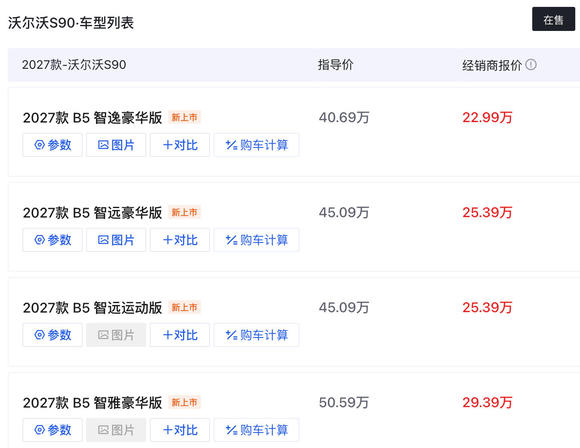
Some dealers are quoting even lower prices under specific financing or trade-in arrangements.
The discounts have provided an immediate lift to sales. Retail sales of the S90 jumped from 388 units in July to 1,554 in August, roughly quadrupling month on month.
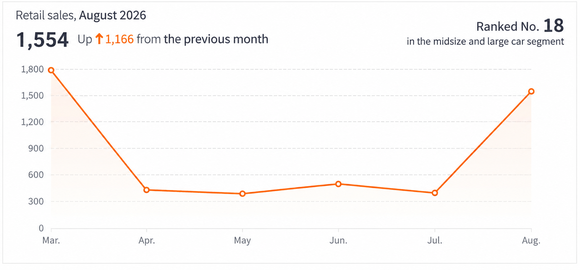
The rebound, however, came from a low base. Monthly sales had fallen to between 400 and 500 units for much of the second quarter, compared with around 3,500 a month in 2023. August sales were only around the model's average monthly level last year.
The S90 competes with the Mercedes-Benz E-Class, BMW 5 Series and Audi A6L in China's midsize and large luxury sedan market.
Its steep discounting comes as Volvo faces mounting pressure in one of its most important markets. The Swedish carmaker sold 710,000 vehicles globally in 2025, down 7% from the previous year, while revenue fell 11% to SEK357.3 billion (US$38 billion). The deterioration has continued in China this year. Volvo delivered 24,882 cars in Greater China in the second quarter, down 35% from a year earlier, following a 17% decline in the first quarter.
Volvo is far from alone.
Mercedes-Benz, BMW and Audi have also cut prices on some of their best-selling models in China this year as sales weaken and Chinese brands make further inroads into the premium segment.
The BMW 5 Series, Mercedes-Benz E-Class and Audi A6L, once relatively resistant to heavy discounting, have all seen substantial price reductions. First-half China sales at BMW, Audi and Mercedes-Benz fell by roughly 20% year on year.
Dealer prices for some BMW 5 Series models have fallen below RMB300,000 (US$45,000), while some Audi A6L variants have been advertised at around RMB260,000 (US$39,000). Discounts of more than RMB100,000 (US$15,000) have also become common on some Mercedes-Benz E-Class and other premium models, although actual transaction prices vary by region, financing package and other conditions.
The shift comes as China's transition toward electric vehicles reshapes a luxury market long dominated by foreign brands.
Passenger-car retail sales nationwide fell 23.6% year on year to 1.54 million units in August, according to the China Passenger Car Association. New energy vehicles accounted for a record 65.2% of retail sales, while sales of conventional combustion-engine passenger vehicles fell about 40%.
Chinese automakers have increasingly moved into higher price brackets with electric and plug-in hybrid models featuring advanced driver-assistance systems, digital cockpits and other technology-focused features.
That has placed additional pressure on established luxury brands, which are simultaneously trying to protect sales, clear dealer inventories and preserve their premium positioning.
For Volvo, the S90 illustrates that tension. Heavy discounts have helped restore some volume, but its August rebound has so far only brought sales back to levels seen last year rather than reversing the model's longer-term decline.