ChinaJoy is evolving into a broader industry platform connecting game developers, publishers, marketers, technology providers and investors.

Photo from CFP
by SHE Xiaochen
This year marks Nitish Mathur's fourth trip to ChinaJoy.
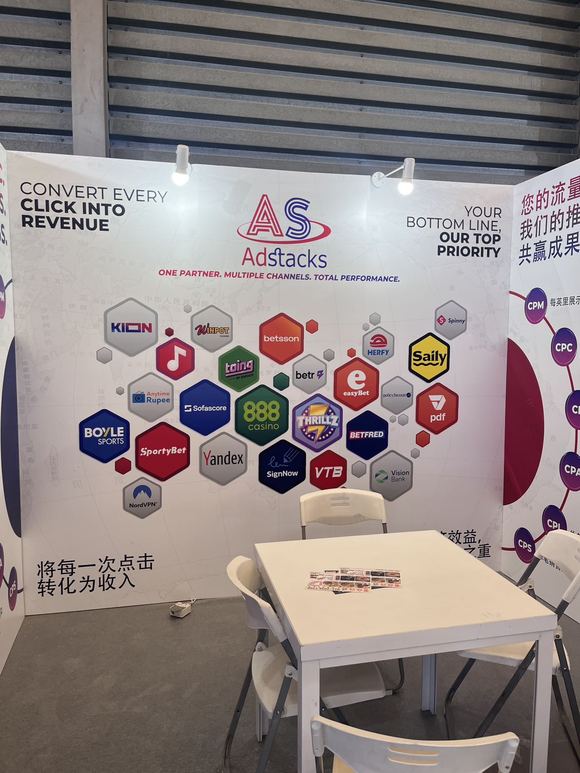
On the second day of the event, Mathur was busy speaking with prospective clients and industry peers at Adstacks Media's modest booth in Hall W4 of the Shanghai New International Expo Center.
The Singapore-based performance marketing agency came to ChinaJoy with a straightforward goal: to meet existing clients and find new customers and partners.
Mathur, the company's chief operating officer, told Jiemian News that Adstacks first attended the event in 2022 and later formed partnerships with several Chinese companies it met there. The team subsequently traveled to Xi'an, Guangzhou and other cities to visit partners in person.
Although Mathur attends industry events around the world almost every month, he considers ChinaJoy one of the gaming industry's largest trade shows and a particularly useful place to identify potential partners. Many of the visitors to the company's booth this year came from the gaming industry, particularly the HTML5 gaming sector, he said.
With artificial intelligence and overseas expansion emerging as two of the main themes at this year's ChinaJoy, the presence of international companies also offered a window into the Chinese gaming industry's growing global reach.
According to an industry report released during ChinaJoy, the United States, Japan and South Korea accounted for 32.31%, 14.05% and 7.48%, respectively, of overseas revenue generated by Chinese-developed mobile games in the first half of the year. Together, the three markets made up 53.84% of the total.
Germany, Britain and France accounted for a combined 10.14%, a slight increase that underscored the growing importance of the European market.
ChinaJoy organizers told Jiemian News that nearly 900 companies were exhibiting this year, including more than 200 foreign companies from 39 countries and regions. Overseas delegations included groups from Poland, Spain and the Philippines, as well as the Korea Creative Content Agency and the Seoul Business Agency.
At the entrance to the business exhibition hall, the logo of AI-powered advertising company Moloco was hard to miss.
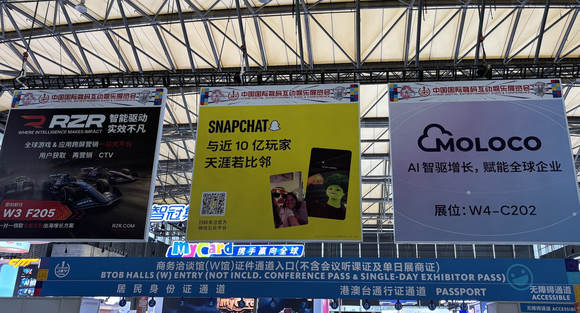
Moloco had attended ChinaJoy before, but it is placing greater emphasis on the Chinese market as more Chinese gaming companies expand overseas. This year, it built a relatively large booth with a second-floor meeting area for business discussions.
The company told Jiemian News that it had reached several preliminary cooperation agreements during the event.
Yet smaller companies such as Adstacks may offer an even clearer indication of ChinaJoy's international appeal.
Along the edges of the exhibition halls, companies from different countries occupied modest booths, using simple displays and eye-catching posters to attract potential clients.
Adstacks has about 50 employees, Mathur said. For companies of its size, the main payoff is not broad brand exposure, but the chance to enter a new market or meet a potential client they would otherwise never encounter.
A business development employee at Chinese overseas marketing company Yeahmobi told Jiemian News that its booth had received a large number of international visitors during the first two days.
One group consisted mainly of overseas marketing agencies hoping to tap Chinese service providers' global networks to support Chinese brands expanding abroad or to fill gaps in markets they had yet to cover.
Another group included advertising platforms and media networks with traffic resources that hoped to reach more Chinese advertisers through partnerships.
The employee said one notable change this year was the growing number of third-party companies offering services for the globalization of games, including advertising, payments and regulatory compliance.
Now in its 23rd year, ChinaJoy is taking on a different role.
In its early years, the event was largely viewed as a platform for Chinese gaming companies to showcase new products and attract players. As the domestic industry has grown and more companies have entered global markets, ChinaJoy has increasingly become a broader business platform linking game development, publishing, marketing, technology services and investment.
An advertising industry professional told Jiemian News that ChinaJoy was no longer simply a gaming exhibition, but also a place to gauge Chinese companies' demand for global expansion.
"Even cross-border clients outside the gaming industry are paying attention to the event," the person said, adding that many of the visitors received on the opening day worked in e-commerce and short-form drama.
In Shanghai, which has a well-established gaming industry, ChinaJoy is attracting not only domestic companies but also overseas businesses seeking to enter or better understand China, as well as those looking for international partnerships.
Chinese game developers are continuing to seek users and growth abroad. At the same time, overseas companies are coming to China to find local partners.
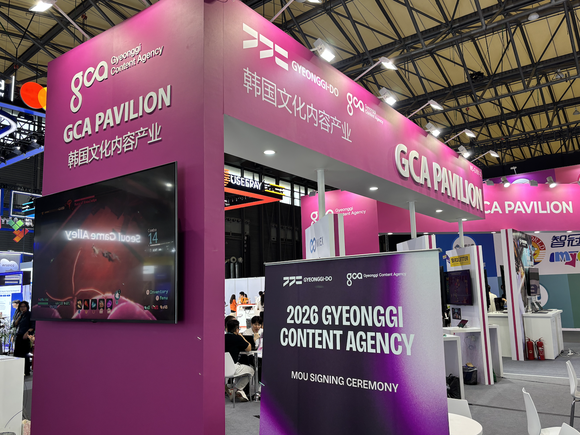
Delegations from Spain, South Korea and other markets took part this year. South Korean organizations and companies have long been regular participants, and many of their gaming businesses have attended multiple times.
The Games from Spain program, organized by ICEX Spain Trade and Investment and the Economic and Commercial Office of Spain in Shanghai, brought 12 Spanish companies and organizations to ChinaJoy for the first time.
A representative at the booth told Jiemian News that the delegation included game developers, esports equipment companies and AI technology providers. All of the participants had traveled from Spain specifically for the event.
This two-way flow of companies, services and resources is giving ChinaJoy a broader significance—not just as a showcase for China's gaming industry, but as a global meeting point for businesses looking for opportunities across markets.