The model race is far from over, but competition is expanding into start-up ecosystems, industrial partnerships and the ability to turn AI into a viable business.

AI-generated image
by ZHA Qinjun, ZHOU Mo
"Yesterday, I attended the main forum, toured the exhibition, went to Zhangjiang to meet start-ups and then joined a small gathering in the evening," ZHENG Tianyi, an investment vice-president at Inno Angel Fund, told Jiemian News.
"I was meeting people almost from morning until night."
That was a common experience for investors at this year's World Artificial Intelligence Conference in Shanghai.
Despite temperatures approaching 40 degrees Celsius, crowds streamed through the exhibition halls. While technology giants unveiled their latest models upstairs, Hall H4 was filled with founders, investors and early-stage companies.
The activity continued long after the official program ended, moving from daytime product meetings to closed-door sessions and after-parties.
The message emerging from interviews with investors and entrepreneurs was clear: the model race remains intense, but competition is widening into start-up ecosystems, industry partnerships and commercialisation.
For CHEN Yuqin, investment director at Fortera Capital and a three-time WAIC attendee, the changing layout of the exhibition reflected the industry's evolution.
Companies from different parts of the value chain were mixed together in previous years, he said. This year, H1 was dominated by models, infrastructure and core technologies, while H4 brought together AI applications and start-ups.
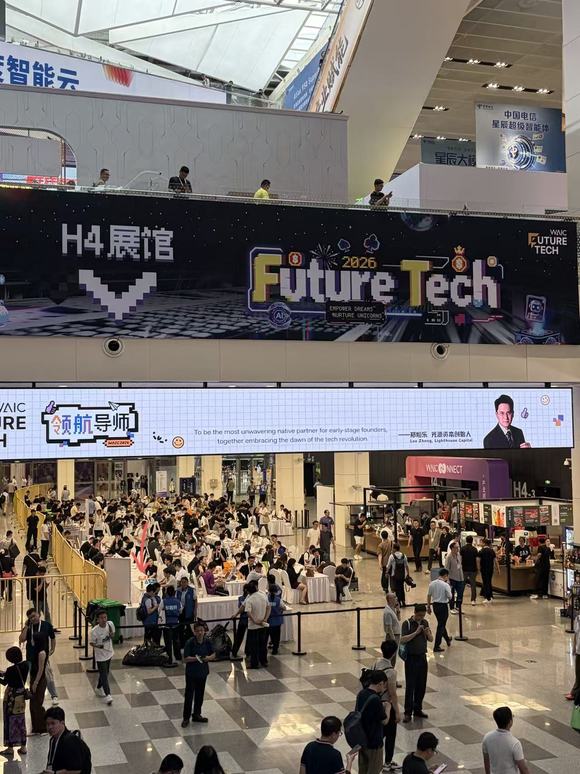
The clearer division suggests that leading positions are beginning to emerge in foundation models and computing infrastructure. At the same time, more young companies are seeking opportunities in specific industries, from AI agents and smart hardware to embodied intelligence.
HU Qi, executive director at Qiming Venture Partners, has watched that shift since the early stages of the generative AI boom.
When Qiming published its first State of Generative AI report at WAIC in 2023, large models still required explanation to many audiences. Three years later, Hu said, they increasingly resemble electricity or the internet: a basic layer on which other products are built.
Industry debate has consequently moved on from whether companies should develop models of their own. The questions now center on how models can become more intelligent, safer, cheaper and more useful to businesses.
Investors' schedules offered another indication of the market's renewed momentum.
LIU Gang, a partner at Alpha Startups, said he added dozens of new contacts on WeChat in a single day and spent his evenings at founder gatherings. ZHOU Yutong, a partner at GSR Ventures, found the conversations outside the conference far more intensive than last year, with discussions continuing from forums into after-parties and the next day's exhibition.
Zheng said the number of projects had increased and their focus had become more varied, spanning AI-native applications, hardware, agents, embodied intelligence and frontier technologies.
Financing conditions have also improved. Chen said valuations had risen particularly quickly in popular fields such as robotics, embodied intelligence and quantum technology, with some companies multiplying in value within a year.
Zheng also detected a strong fear of missing out among investors concerned about overlooking the next leading AI company.
But while more projects are entering the market, capital is becoming concentrated in a relatively narrow set of areas.
Zhou said foundation models, embodied intelligence and frontier technologies remained among the main targets. Hu similarly saw resources gathering around models, robotics and AI infrastructure.
"Everyone talks about differentiation, but at the broadest level, the industry's priorities are actually becoming more aligned," Hu said.
As foundation models extend into coding, agents and productivity tools, they are also moving into territory previously occupied by application start-ups.
That has revived a central question for founders: how much room will remain for independent applications as the underlying models become more capable?
Zhou said companies offering little more than a simple interface around current model capabilities were particularly exposed. A model upgrade could absorb much of their functionality almost overnight.
Applications with specialist data, established customers, distribution channels or deep industry expertise are better placed to defend their position, particularly in enterprise markets.
Hu said advances in models would eliminate some application opportunities but create others. Functions that applications now provide may gradually be internalised, while stronger models will make new types of products possible.
Applications will not disappear, he said, but the opportunities will keep moving.
Chen was more cautious about predictions of an imminent application boom. China still faces a shortage of high-quality inference capacity, he said, with some leading model companies restricting unlimited use or raising prices as computing resources remain tight.
Without sufficient infrastructure, many application companies may be reluctant to expand aggressively. Chen therefore continues to see inference chips, inference architecture and other infrastructure technologies as central investment opportunities.
This also explains why investors use different standards for different parts of the market.
For foundation-model companies, technological breakthroughs and the expansion of model capabilities may matter more than early revenue. Application companies, by contrast, usually need to demonstrate commercial demand sooner.
Zheng said the industry had not reached a stage in which capital was focused only on applications. Language models were still scaling, while foundation models for embodied intelligence, human-machine interaction and self-evolving systems remained unsettled and continued to change rapidly.
Many potential routes towards artificial general intelligence therefore remain at the model layer, she said.
As AI tools become more powerful, the barrier to launching an application is falling.
Chen said one-person companies and very small teams were becoming more common. Founders born after 2000 often treated AI not simply as a productivity tool but as an ordinary part of daily life, giving them a more instinctive understanding of AI-native products.
In this environment, he said, strong product judgement may prove even scarcer than raw technical talent.
Zhou said a single founder could now build and release a product within one or two weeks. That speed is drawing more young entrepreneurs into AI, but it is also making individual products easier to replicate.
Lower development costs therefore do not mean lower investment standards.
Zheng said investors looked for product instinct, creativity and AI-native thinking in application founders. Teams developing foundation models, chips or quantum computing still needed strong technical records, engineering experience and the ability to build an organisation.
With capital readily available for fashionable AI projects, funding itself may no longer be the main constraint.
Zheng said she was more interested in a founder's creativity, judgement and ability to learn and iterate quickly. The decisive question was not simply whether a company could raise money, but whether its founder chose the right problem at the right time.
Hu identified organisational design as another emerging challenge.
AI is changing not only technology but also how companies operate. There is little mature management experience for founders to copy, because organisations must keep adjusting as models improve.
The ability to adapt the organisation at the same speed as the technology could itself become a competitive advantage, he said.
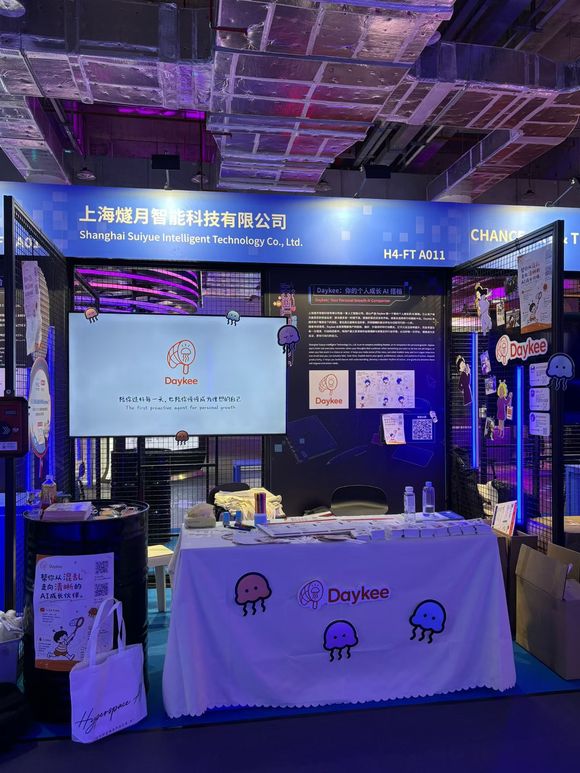
That new generation of founders was visible in one corner of Hall H4.
An entrepreneur born in 2002 showed Jiemian News an AI agent developed by his year-old company. The product is designed as a digital life companion, helping users organise ideas, plan tasks and manage daily routines.
It was the team's first WAIC. In two days, its members met investors and potential partners from museums and arts organisations.
"It feels exhausting," the founder said, before adding: "But many people are interested in our project."
The exchange captured the mood at this year's conference. One part of the AI industry is becoming more mature and clearly segmented. Another continues to produce young founders, small teams and experimental products.
That is also the purpose of WAIC Future Tech, which gives early-stage companies their own exhibition space.
Major corporate launches naturally attract the largest crowds, Chen said, but younger companies have a greater need for capital, customers and industry resources. Bringing them into one hall makes it easier for founders to meet investors and for investors to identify projects.
No one knows where China's next AI unicorn will emerge. But amid the models, applications, capital and new talent gathered at WAIC, the search is already well under way.