Competition is shifting from the performance of individual chips to systems engineering and the ability to deliver usable computing power.

Huawei's Atlas 950 SuperPoD. Photo by Zhou Mo
by ZHOU Mo, SHE Xiaochen
At the World Artificial Intelligence Conference in Shanghai, a row of 20 black cabinets occupied almost half an exhibition wall. It looked less like a server than a small data centre brought onto the show floor.
The installation was Huawei's Atlas 950 SuperPoD, displayed physically in China for the first time. The configuration at WAIC contained 1,024 neural processing units, with Huawei claiming 1 exaFLOPS of FP8 computing power and 2 exaFLOPS at FP4 precision.

Similar systems filled this year's computing hall.
ZTE displayed an OEX supernode developed with Chinese GPU suppliers. Alibaba Cloud presented a system using its Zhenwu M890 and Panjiu AL128 processors, while Sugon showcased ScaleX, designed to support clusters containing as many as 100,000 accelerator cards.
The proliferation of supernodes reflects a shift in China's AI computing industry. Domestic companies are no longer trying only to prove that they can develop an AI chip. They must also show that they can connect large numbers of chips into stable systems that customers can deploy.
Peak chip performance remains important, but it does not determine how much computing power a customer can actually use. As models and clusters grow, performance increasingly depends on how processors communicate, how workloads are distributed and how quickly systems recover from failures.
Traditional AI clusters typically connect servers containing eight accelerator cards through scale-out networks. Supernodes expand the scale-up domain, linking far more processors through high-bandwidth, low-latency connections.
The aim is to make hundreds or thousands of chips behave more like a single computing system.
Demand for such systems is rising as AI workloads move beyond model training towards large-scale inference and agent applications.
PENG Li, co-founder and CTO of Chinese GPU developer MetaX, told Jiemian News that inference involved more frequent and fine-grained communication than training, making high-speed interconnection particularly important.
A Lenovo representative said many Chinese customers were already using supernodes mainly for inference. Instead of focusing only on theoretical computing power, they were paying closer attention to the number of tokens a system could generate each second and the cost per token.
Supernodes have also become one way for Chinese suppliers to offset constraints in access to advanced semiconductor manufacturing. When it is difficult to achieve the required performance through a single chip, companies can try to improve overall computing capacity by connecting more accelerators.
But adding chips is only the beginning.
Lenovo's 40-card supernode, for example, consists of 10 computing blades connected through switching equipment at the rear of the chassis. A company representative said the design reduced on-site cabling and allowed the product to be delivered as a complete rack.
ZTE's system incorporates internally developed CPUs, network interface cards, data processing units and switching chips.
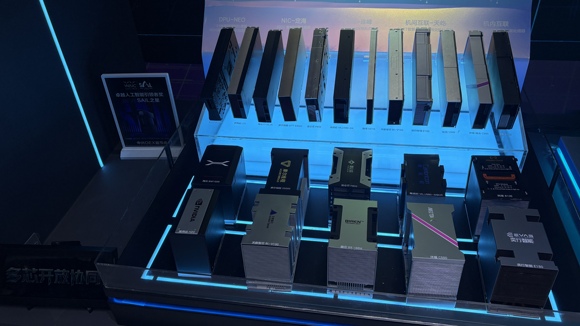
A ZTE representative told Jiemian News that competitiveness depended not only on the number of GPUs, but also on interconnect bandwidth and latency, as well as the ability to optimise chips, servers, networks and software together.
Peng said the management challenge also grew rapidly as more cards were connected. Suppliers must monitor each processor, identify communication failures, preserve diagnostic information, restore interrupted jobs and divide workloads among chips.
"It is more of a systems capability," she said.
The large numbers displayed at WAIC do not mean the supernode market is already mature.
A representative of Inspur told Jiemian News that chipmakers, internet companies and telecommunications operators had yet to agree on a common standard for GPU interconnection. Server suppliers therefore often have to coordinate between customers and multiple chip companies.
Software remains another hurdle. A chip may be physically compatible with a server, but applications and development tools must still be adapted to the underlying hardware.
This remains one of the biggest differences between domestic computing platforms and Nvidia's CUDA ecosystem, which has been developed over many years.
The specifications disclosed by companies are also not always directly comparable. A system with more cards does not necessarily deliver better performance under real workloads.
Jiemian News learned that most supernodes currently deployed in China contain fewer than 100 accelerator cards. Larger configurations may demonstrate engineering capabilities, but do not necessarily reflect immediate customer demand.
MetaX, for example, first introduced a 64-card cabinet with the option to expand to 128 cards.
Peng said 64 cards were already sufficient for many current models, while larger configurations could result in unnecessary costs.
Scaling beyond an individual supernode also introduces further challenges. Supernodes must be connected through scale-out networks to form clusters containing tens of thousands of accelerators.
Peng said China was broadly capable of building clusters with around 10,000 cards, but expanding towards 100,000 would make long-term network stability far more difficult. Greater processor density also raises requirements for electricity, cooling and data-centre construction.
LI Liu, vice-president of Sugon, said at a WAIC forum that supernodes were moving from customised high-end equipment towards more standardised computing units.
Standardisation and modular design, he said, would be essential if the technology was to be adopted more widely.
The concentration of supernodes at WAIC shows that China's AI computing sector is moving towards systems-level competition.
Chipmakers such as Huawei and MetaX are extending downstream into system design. Server companies including ZTE, Lenovo and Sugon are moving upstream into switching chips, interconnection protocols and liquid cooling.
Internet companies occupy both sides of the market. Alibaba, ByteDance and Tencent are major buyers of computing resources, but they also operate cloud platforms and large models, giving them an incentive to help design chips, servers and networks around their own workloads.
Some have also developed processors of their own. Inspur's supernode at WAIC, for example, was developed with Kunlunxin, the AI chip company associated with Baidu.
Other companies are exploring alternative chip architectures.
Dongfang Suanxin (Shanghai Orient Computing Core Technology Co., Ltd.) publicly displayed its DF1000 at WAIC for the first time. The company describes it as the world's first software-defined, near-memory 3D AI chip.
The chip combines a software-defined architecture with 3D-stacked near-memory computing, placing memory closer to the processor to reduce data-transfer bottlenecks.
Dongfang Suanxin says the design allows a chip made using a mature 14-nanometre-class process to approach the performance of products manufactured on a 4-nanometre process. The comparison has not been independently benchmarked and will depend on the workload and performance measure used.
WEI Shaojun, the company's founder, chairman and chief executive, said competition in computing would ultimately be decided by systems and ecosystems.
That argument is already being tested.
In October 2023, iFlytek and Huawei launched Feixing No. 1, which they described as China's first large-scale computing platform built entirely on domestically developed hardware and software.
Jiemian News learned that its initial training efficiency was about 30% of that of a similarly sized Nvidia-based cluster. After improvements to operators, distributed training strategies and other engineering components, the figure rose to between 84% and 93%.
The figures illustrate why system optimisation matters. The same underlying hardware can deliver very different results depending on how the chips, software and workloads are integrated.
The shift is also creating demand elsewhere in the supply chain.
ZHUANG Dan, executive director and president of Yangtze Optical Fibre and Cable (YOFC), said at a WAIC forum that growth in global fibre demand was increasingly being driven by computing centres rather than telecommunications networks.
He forecast that demand for polarisation-maintaining fibre could increase tenfold or even twentyfold over the next one to two years as high-performance processors and silicon photonics are adopted more widely.
ZOU Xuan, vice-president of Iluvatar CoreX, said AI computing demand was expanding from training into inference and edge computing as large models entered more business applications.
Peak performance would remain important, he said, but actual results would increasingly depend on coordination between chips, software, clusters and applications.
That is the broader message from this year's WAIC. China's AI computing companies are still competing on chips, but the harder contest is moving behind the chip itself: into interconnection, software, reliability and the ability to turn theoretical performance into computing power that customers can use.