AI is moving beyond software demonstrations and into factories, pharmacies and workplaces, as robotics companies, model developers and domestic computing firms compete to prove their technology can work in real-world settings.

Photo from Jiemian News
by SHE Xiaochen
The 2026 World Artificial Intelligence Conference and High-Level Meeting on Global AI Governance is being held in Shanghai from July 17 to 20 under the theme "Intelligent Partners, Co-creating the Future."
The exhibition covers more than 100,000 square meters for the first time, with over 1,100 companies presenting more than 3,000 products and technologies. More than 300 AI products are expected to make their global debuts.
Tickets have been difficult to secure. Since the emergence of the latest wave of large language models, the annual conference, known as WAIC, has become one of China's leading showcases for developments across the AI industry.
On the opening day, Jiemian News visited the exhibition to examine some of this year's main products and technology trends.
Across the venue, companies were delivering a consistent message: AI is moving from computer screens into factories, pharmacies and offices. Robots and large models are no longer being presented merely as technical demonstrations, but as tools intended for specific commercial tasks.
Computing infrastructure was another major focus, with Chinese chipmakers and computing companies unveiling products designed to support the country's growing AI industry.
At the Shanghai World Expo Exhibition and Convention Center, robots provided the most immediate visual impact.
The Modeng Era: City of Partners exhibition on the first floor recreated a neighborhood inspired by Shanghai's traditional shikumen architecture. Its three areas covered manufacturing, everyday life and entertainment, with robots carrying out tasks including industrial production, logistics sorting and food services.
Sharpa, which was attending WAIC for the first time, demonstrated a robot taking photographs autonomously.
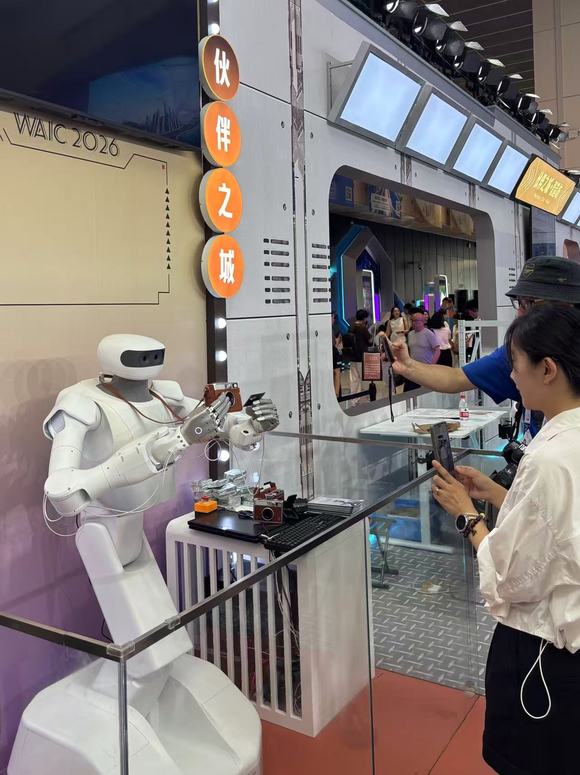
A company representative told Jiemian News that the demonstration tested the robot's manipulation capabilities. The technology could eventually be used for flexible, precision work involving different handheld tools, the representative said.
Several of China's best-known robotics companies also presented increasingly diverse machines and applications.
Unitree Robotics displayed the GD01, which it described as the world's first passenger-carrying transforming robot. The machine can switch between humanoid and quadruped configurations.
AgiBot's Expedition A3 Ultra was selected as one of the conference's flagship exhibits. The company describes it as the first full-size humanoid robot designed for mass production and commercial deployment. Equipped with its proprietary embodied-intelligence system, the robot has been tested in factory inspection and materials-handling operations.
Fourier Intelligence presented its "Embodied Home" technology portfolio, including the wheeled dual-arm GRW, the compact bipedal GR Mini and the desktop-sized GR Nano. The GR Nano drew particularly large crowds because of its small form and interactive features.
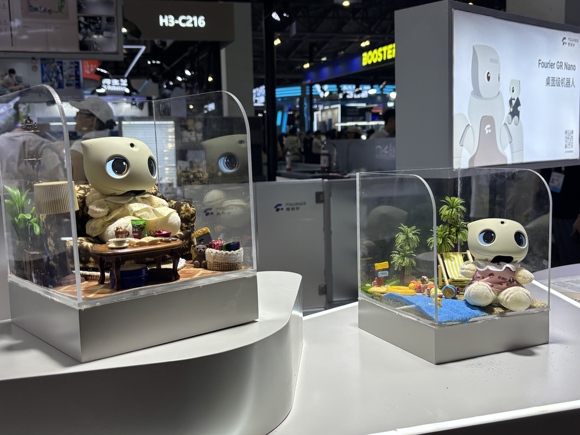
Practical applications were a central theme of this year's robotics displays. Compared with the logistics, sorting and entertainment demonstrations common at previous exhibitions, more companies were recreating everyday workplaces.
Pharmacy settings appeared at the booths of Robbyant, Noematrix and Kepler Robotics, among others.
At Robbyant's exhibition area, Ant Group's robotics subsidiary recreated a branch of Chinese pharmacy chain Guoda Drugstore. Three robots with different physical configurations shared what the company called a single "general-purpose brain" and demonstrated the full process of receiving an order, retrieving medicine and handing it to a customer.
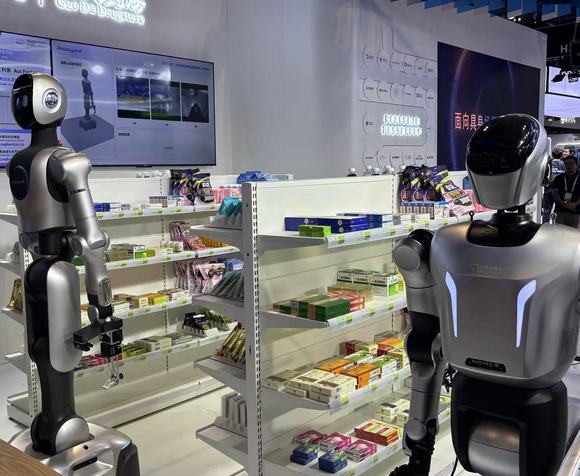
A representative told Jiemian News that the system had already been deployed at a Guoda pharmacy.
Noematrix, which focused more heavily on individual robot capabilities at last year's conference, presented a more complete technology loop this year, with applications including pharmacy operations and hotel laundry services.
There were also more first-time exhibitors. Alongside robotics start-ups, component suppliers and other companies across the embodied-intelligence supply chain were seeking potential partners.
Shanghai start-up Futuring Robot, founded in 2022, attended WAIC for the first time with a robot designed for household environments.
Hall H1 brought together the latest products in large models and AI agents.
Beyond model sizes and benchmark rankings, competition is becoming more comprehensive. Large models are moving from answering questions to carrying out tasks, while AI agents are being positioned as workplace productivity tools rather than conceptual demonstrations.
The booths of Shanghai-based model developers MiniMax and StepFun attracted large crowds.
StepFun presented products covering foundation models, an agent operating system and AI-powered devices.
A representative told Jiemian News that the company was displaying its latest Step model series, along with Step Agentic-native OS, or Step AOS, which it describes as the world's first operating system designed natively for AI agents.
Hardware was a particular focus. The STEPX Neo agentic smartphone, another of the conference's flagship exhibits, made its first offline public appearance.
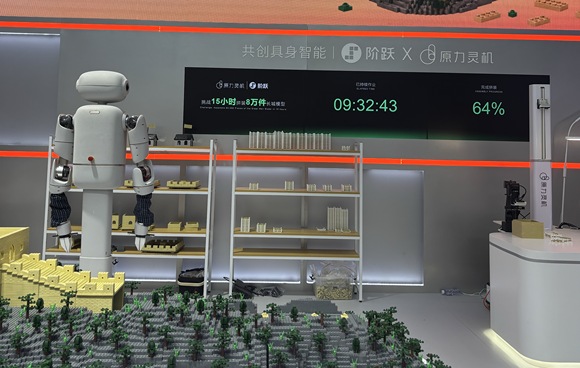
StepFun and robotics company Dexmal also launched a demonstration in which six robots worked together for 15 consecutive hours to assemble a model of the Great Wall using more than 80,000 building blocks.
MiniMax showcased its flagship M3 model alongside multimodal models and AI-native products. It also previewed H3, its next-generation multimodal generation model.
Through partnerships involving robotic dogs, AI glasses, smart earphones, network-attached storage, financial services and film production, MiniMax demonstrated M3's long-context, coding and agentic capabilities. Visitors could also explore applications of its multimodal models in content creation, smart hardware and industry services.
Displays by China's largest technology companies remain a major focus at WAIC each year. Baidu, Tencent, Ant Group and Alibaba were all present, each emphasizing different areas but seeking to demonstrate broad, full-stack AI capabilities.
Baidu's main exhibit was DuMate, the only general-purpose AI agent among WAIC's 10 flagship products.
According to a demonstration by booth staff, users can describe a task in natural language and ask DuMate to process files, analyze data, write reports or produce PowerPoint presentations.
Ant Group presented a three-layer AI strategy covering consumer applications, commercial agent services and underlying technology. Its displays included AI assistants A-Fu and A-Bao, AI payment services, an Alipay AI development platform and merchant agents linked to the company's tap-to-pay system.
Alibaba's exhibition covered chips, servers, model-as-a-service platforms, agent products, AI applications and smart hardware. Its Qwen-powered AI glasses remained one of the most crowded parts of the booth.
AI computing infrastructure was another major attraction, drawing heavy crowds to Hall H2.
Huawei Ascend, Enflame Technology, Iluvatar CoreX, Biren Technology, MetaX, Sugon and Moore Threads were among the Chinese companies exhibiting.
Competition is moving beyond the specifications or peak performance of individual chips. Companies are increasingly emphasizing supernode architecture, large-scale clusters, systems engineering and the ability to deploy complete computing solutions.
Huawei publicly displayed a physical Atlas 950 SuperPoD system for the first time. It is the company's latest-generation supernode product for large-scale AI training and inference and is intended to meet the computing demands of increasingly large models.
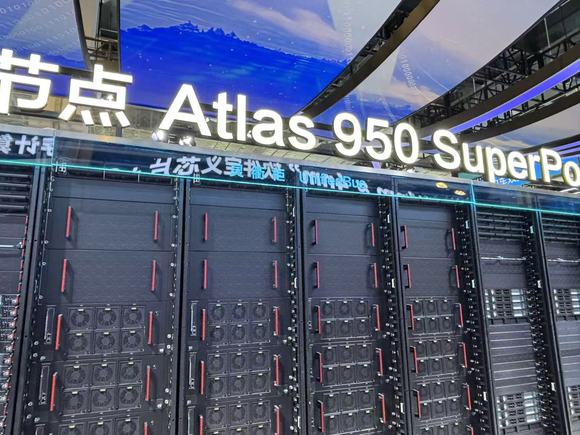
Jiemian News learned that more than 750 units of Huawei's Atlas 900 A3 SuperPoD, previously known as the Ascend 384 SuperNode, have been commercially deployed in industries including internet services, telecommunications, finance, education, health care, transportation and manufacturing.
Dongfang Suanxin, or Shanghai Oriental Computing Technology, also drew attention after unveiling its first high-performance chip, the DF1000, shortly before the conference.
The company describes it as the world's first software-defined, near-memory computing 3D AI chip. It says the processor delivers 520 TFLOPS of BF16 computing power, 6.4TB per second of memory bandwidth and 900GB per second of scale-up interconnection bandwidth.
Sugon displayed its ScaleX large-scale computing cluster. The company said its ScaleX system, deployed at the Zhengzhou core node of China's national supercomputing network, was designed to combine high-precision scientific computing with AI workloads.
The system is intended for AI for Science, or AI4S, applications that use artificial intelligence to address complex research problems.
Taken together, the products displayed at this year's WAIC point to a broader shift in China's AI industry. Competition is moving away from model parameters and eye-catching demonstrations and toward deployment, engineering and commercially viable applications.