Haute couture is Balenciaga's past—and a way forward.

Photo from Balenciaga
At noon on July 8 in Paris, fashion stars and prominent guests took their seats in the open-air circular garden of the Cité Internationale Universitaire de Paris. Fans fluttered constantly in the heat, but all eyes were fixed on the main building at the end of the garden's central axis. From there, models would emerge to present Balenciaga The 55th Couture Collection.
It was Pierpaolo Piccioli's first couture collection for Balenciaga since taking the helm of the house in 2025. But its status as a debut was only part of the anticipation.
Haute couture holds particular significance for Balenciaga. It is where the house began and the foundation of its standing in fashion. After Cristóbal Balenciaga founded his fashion house in 1917, couture remained its sole business for the next three decades, during which he created 49 collections.
Balenciaga couture was absent for half a century before its revival in 2021. Collections 50 through 54 were presented by then artistic director Demna, with each annual show preserving and carrying forward the values at the house's core.
Now that responsibility has passed to Piccioli.
Compared with Demna, Piccioli's aesthetic is closer in some respects to Cristóbal Balenciaga's. His ready-to-wear collections for the house have already shown his ability to revisit its archive while balancing his own identity with the marks left by his predecessors. Couture offers an even more exacting and experimental field, but its principles and methods have long been familiar territory for Piccioli.
All of this raised expectations for the show—particularly after he offered a distinctly personal preview.
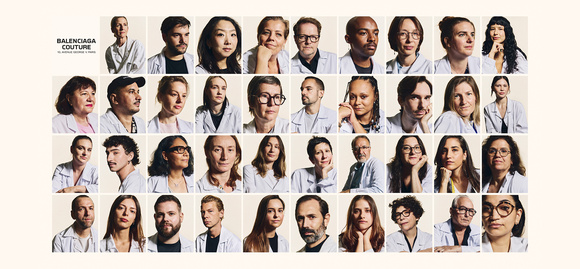
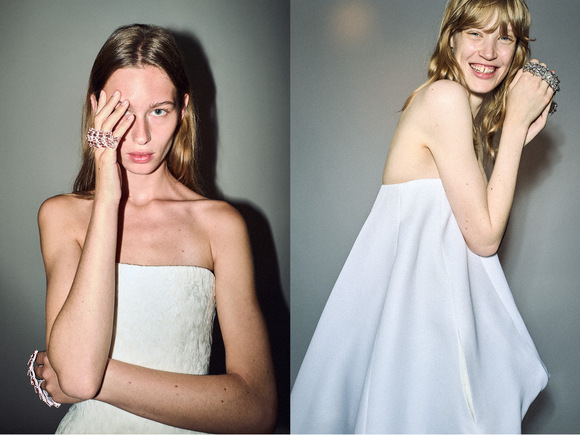
Ahead of the presentation, Balenciaga shared individual portraits on social media, each bearing the subject's name and role. They were the artisans behind Balenciaga couture.
"These are the people, the human beings who built this collection with me. These are the faces, these are the hearts. This is the identity of BALENCIAGA Couture," Piccioli wrote.
Those familiar with his work will recognize the humanism at its core. Piccioli has long been known for his commitment to inclusion and for treating his teams as equals. Creatively, this translates into a belief in humanity as a source of inspiration, with people placed at the center.
This time was no exception.
Piccioli's Balenciaga couture debut opened to British singer Anohni's cover of "I Could Fall in Love," a song about the struggle of falling for someone one should not love. Its complex, intense emotion made it an understandable choice for Piccioli.
The music was, in effect, part of the collection. Haute couture is never simply an assemblage of looks; it is a complete narrative.
It therefore has both structure and grammar. For Balenciaga couture, the most fundamental element of that grammar is the silhouette established by Cristóbal Balenciaga.
The master often described as "the couturier's couturier" was fascinated by the relationship between the body, clothing and the space between them. Like an architect, he studied curves and structural shifts, using spare lines to create sculptural forms. Clothes did not cling to the body but surrounded it. From this exploration came signatures including the cocoon coat, sack dress, envelope dress, balloon dress and one-seam wedding dress.
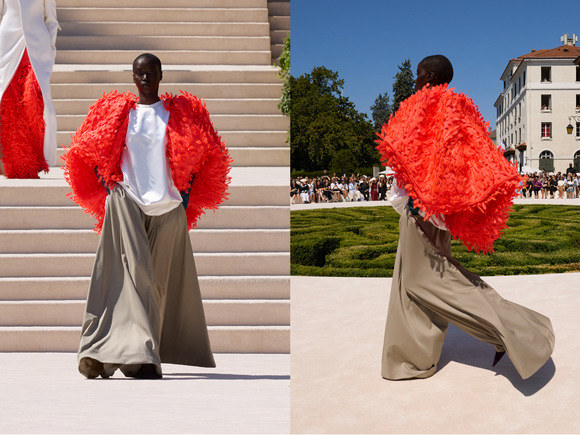
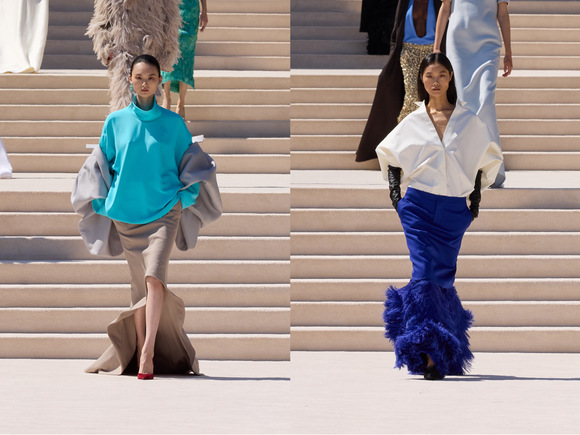
These forms resurfaced throughout the collection. After several ready-to-wear seasons, Piccioli appeared increasingly fluent in handling them. The opening look, an orange-red feathered cape, reinterpreted the balloon silhouette. It retained the generous space between body and garment and appeared full from every angle. Feathers and vivid color, meanwhile, brought lightness and romance to the solemnity of its architectural form, setting the collection's tone.
Following a classical grammar does not mean being rigidly bound by it. The subsequent looks moved between pared-back restraint and lavish abundance.
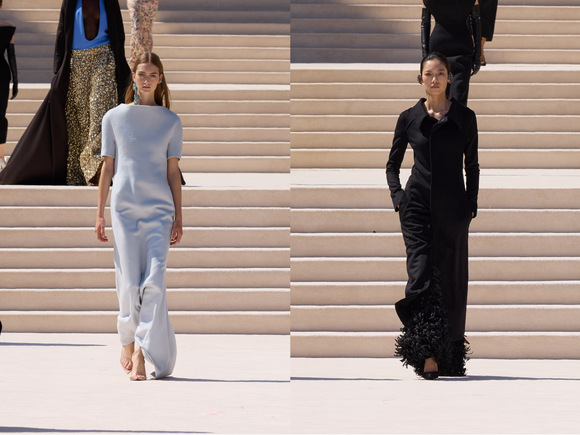
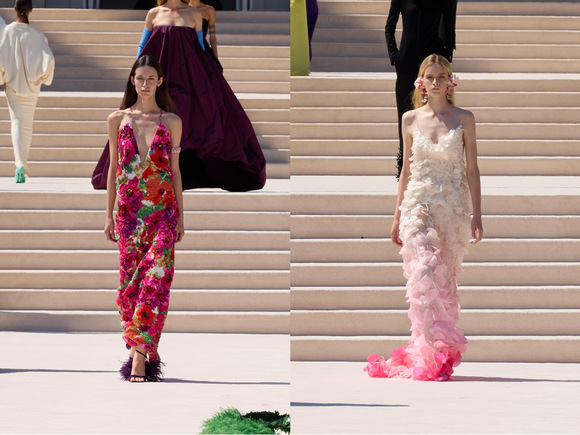
In one thoughtful device, Piccioli repeated certain looks. On their second appearance, they were stripped back to pure black silhouettes, like shadows cast by garments in light. The effect redirected attention to line and form.
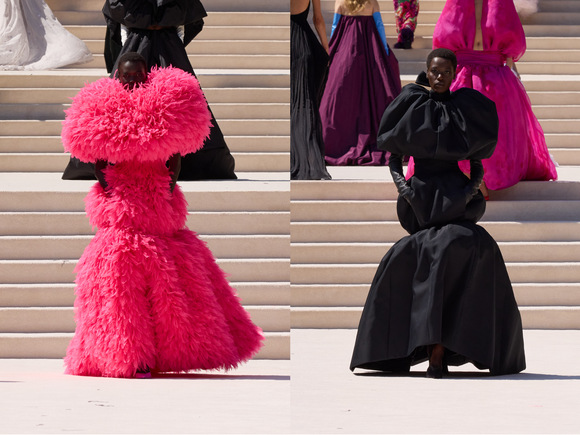
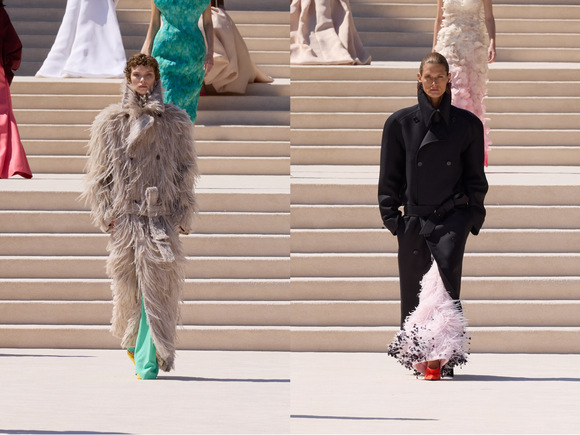
Just as distinctive architecture depends on particular materials and techniques, Balenciaga's three-dimensional silhouettes rely on fabric and construction.
In Cristóbal Balenciaga's time, such forms were perfected through countless hours in the atelier and repeated rounds of fitting, stitching and adjustment.
Today, technology offers new possibilities. Several cashmere tailored coats and gowns employed 3D body-scanning technology. Rather than relying solely on the eye and experience, the process captures the body's natural posture with greater precision. This becomes the basis for an internal leather support structure, allowing a garment to retain sculptural volume while appearing light.
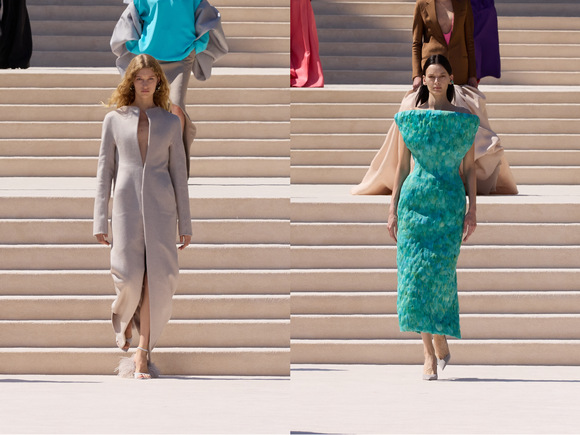
This is what audiences expect from couture. As the highest expression of a house's dressmaking capabilities, Balenciaga couture has long served as a testing ground for innovation.
Fabric development is one of its defining traditions. A classic example is Gazar, developed by Cristóbal Balenciaga more than half a century ago. Crisp yet light, it allowed him to create entirely new silhouettes.
Balenciaga later developed Neo-Gazar, further refining those qualities. Introduced in Piccioli's ready-to-wear debut for the house last year, it appeared across more than 10 couture looks, including the opening one.
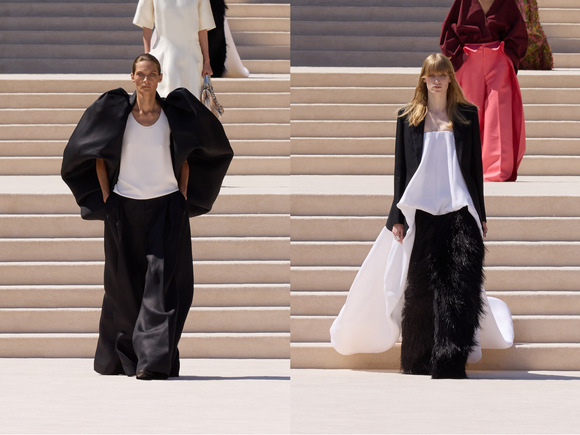
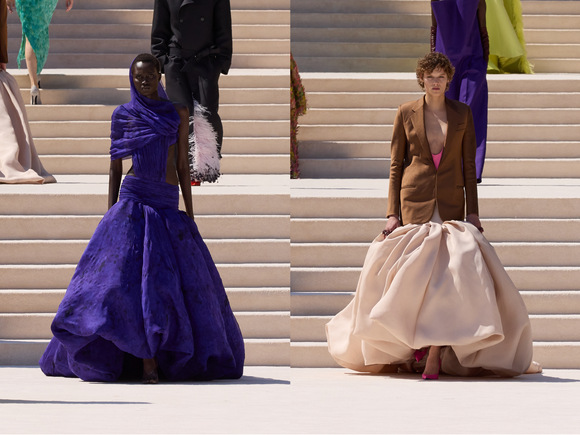
Without being told, few viewers might have noticed what distinguished Look 32, a pure white dress based on the classic sack silhouette.
The difference was its fabric. It was the collection's only look made with AMSilk bioengineered protein silk, marking the material's first use in Balenciaga couture. Developed with the Munich-based technology company, it is presented as a scalable alternative to conventional silk. It offers greater elasticity and wrinkle resistance, with a lower environmental burden, while remaining almost indistinguishable in appearance and touch.
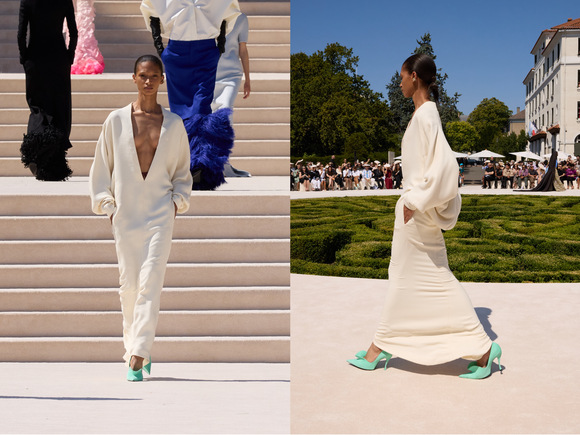
If advances in fabric depend on technology, advances in craft depend on an uncompromising pursuit of workmanship.
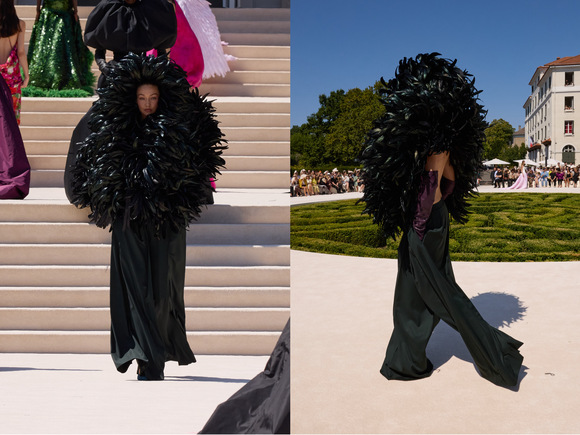
Feathers were a central motif, appearing in varied forms and degrees. They had to convey more than lightness: they needed to breathe while holding shape. The most visually arresting example was Look 47. Created with milliner Philip Treacy, a sculptural black-feather headpiece gently enveloped Gigi Hadid, dissolving the boundary between hat and garment.
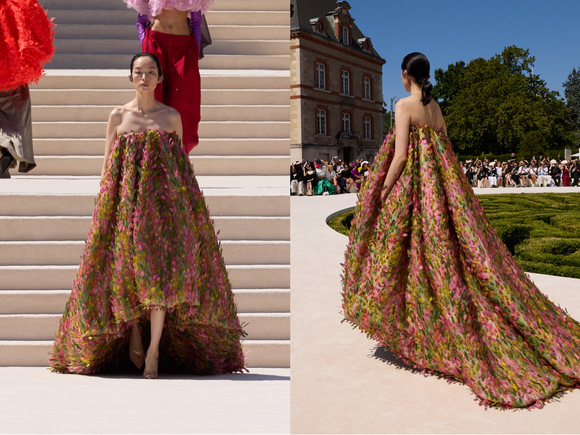
Embroidery, too, was treated not merely as decoration but as part of the silhouette. Several looks used three-dimensional tubular embroidery to add texture to pared-back forms. Look 8, worn by Chinese supermodel Fei Fei Sun, was particularly representative. Based on a one-seam wedding dress, the strapless gown was covered with more than 24,000 Neo-Gazar petals. Moving in layers with each step, they cast a hazy veil over its fluid lines, like an Impressionist painting.
Under Piccioli, the collection continued Balenciaga's dialogue with the traditions established by Cristóbal Balenciaga while adding a distinct personal voice and taking craftsmanship beyond his earlier ready-to-wear work.
Yet Balenciaga couture has never been an island devoted only to reproducing the archive or expressing a designer's will. It is also connected to society and its time.
Beyond its visual impact, the collection was grounded in a human-centered idea.
Silhouettes are made to serve people. They are not merely aesthetic symbols to be observed; they also account for the wearer's body. The sculptural forms do not emerge in a vacuum but from the spatial relationship between body and clothing.
The soundtrack was curated by Anohni, with whom Piccioli has collaborated several times. It included classics from the last century, her own work and music from The Imitation Game. Though drawn from different periods and contexts, the selections all carried intense human emotion.
The Imitation Game tells the story of Alan Turing, widely regarded as a father of computer science. Aspects of his experience resonate with Anohni's own life. This attention to individual experience closely reflects Piccioli's humanist philosophy.
At the end of the show, Piccioli did not take his bow alone. He descended the steps with Balenciaga's couture artisans, dressed in white coats, sharing the closing attention with those whose hands had built the clothes.
His written notes were also dedicated to them rather than to an elaborate interpretation of the work. "This collection, is the result of the work of the people in the atelier, human beings who are couture— because couture is made by the people who live it."
Putting people first has long defined Piccioli's approach. But it is also a thread embedded in Balenciaga from the beginning and interpreted differently across eras. Cristóbal Balenciaga's silhouettes freed women's bodies from traditional tailoring. Demna reproduced everyday objects through elevated craftsmanship, placing luxury within ordinary experience. Piccioli is now extending and amplifying that thread.
Humanism may not sound particularly cool today; it may even seem old-fashioned. Yet as AI advances and technology continually redefines human agency, Piccioli's decision to revisit the idea through couture speaks to the resulting uncertainty. It asks how and why people should still be cared for, and affirms that human beings possess value in themselves. Today, that affirmation is a form of avant-garde rebellion.
More broadly, Piccioli's accomplished debut has reinforced Balenciaga's position in the industry.
Haute couture sits at the pinnacle of fashion, attracting some of the luxury industry's greatest creative investment. Yet houses are separated not simply by technical virtuosity, but by the depth of thought behind their work. In this sense, Balenciaga has consistently remained at the forefront.
An avant-garde spirit has always been central to its couture.
At a time when couture celebrated visible technique, ornament and the body's curves, Cristóbal Balenciaga concealed technique and freed the body through pared-back silhouettes. Demna broke down boundaries between luxury and everyday clothing, challenging divisions of class and taste. Piccioli is now reviving humanism as human agency and individual value come under strain.
The avant-garde takes different forms in different eras. Balenciaga's tradition of engaging with the present also answers a recurring question: is couture merely an outdated relic? The house has shown that its value lies not in how many people it serves, but in the depth of thought behind the clothes and their capacity to respond to their time.
The luxury market remains in a period of deep adjustment. Financial pressure is mounting, while patience for long return cycles is narrowing. Yet Balenciaga is still willing to slow down and devote resources to couture.
The reason is clear. Luxury brands do not invest in couture for immediate commercial conversion, but to establish brand value and industry standing. Neither depends on how many blockbuster products a house can produce in one quarter, but on the creative heights it can reach.
Beyond intangible value and status, each Balenciaga couture collection has added incrementally to the house's assets. Over time, those gains enter tangible products. New silhouettes, fabrics and techniques are absorbed into the house before filtering into work for a broader audience, nourishing Balenciaga's wider product and aesthetic system.
Haute couture is Balenciaga's past—and a way forward.