In April, China's electric passenger vehicle exports top 500,000 units for the first time in 2026, Brazil rises to the top destination spot. Chinese automakers are stepping up overseas production, technology partnerships and smart-driving service exports.

Photo from Jiemian News
by JIA Lu
Editor's note: To provide more timely, comprehensive and accurate insights into China's electric passenger vehicle exports, Jiemian Intelligence and SINOIMEX jointly launched the China Electric Passenger Vehicle Export Monthly Report in March 2025. The report tracks monthly changes in export value, export volume and destination markets, providing reference for governments, companies and investors.
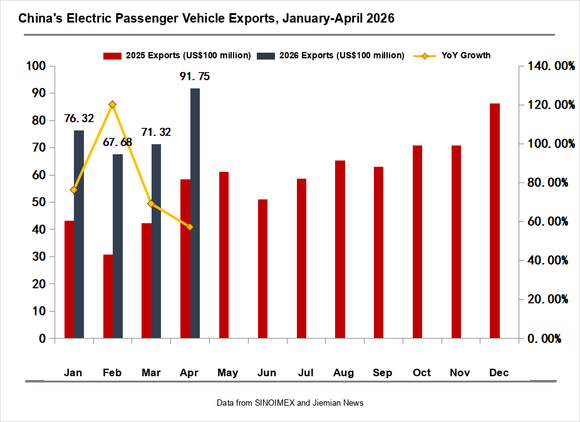
China's electric passenger vehicle trade continued to expand in April, according to data compiled by Jiemian Intelligence and SINOIMEX. In the first four months of 2026, total trade reached US$31.64 billion, up 71.44 per cent from a year earlier. Exports remained the main driver, with cumulative export value rising 75.83 per cent to US$30.71 billion and export volume climbing 71.29 per cent to 1.64 million units.
April itself kept the sector on a high-growth track, even though the pace moderated from March. Export value reached US$9.18 billion, up 57.13 per cent year on year and 28.64 per cent from March. Export volume rose 64.01 per cent from a year earlier and 34.37 per cent month on month to 505,300 units. Average export prices stood at US$18,157.20, down 4.19 per cent year on year and 4.27 per cent from March.
Passenger vehicles remained overwhelmingly dominant. In April, they accounted for 99.76 per cent of export volume and 97.42 per cent of export value. Passenger-car export value rose 60.04 per cent year on year to US$8.94 billion, while shipments increased 64.45 per cent to 504,100 units. Average export prices for battery-electric passenger vehicles fell 5.80 per cent from a year earlier, while plug-in hybrid prices edged up 0.48 per cent and non-plug-in hybrid prices slipped 1.31 per cent, showing clearer differentiation across powertrain categories.
Bus exports presented a contrasting picture. April bus shipments fell 22.40 per cent year on year to 1,202 units, while export value declined 8.20 per cent to US$236 million. Average export prices, however, rose 18.30 per cent to US$196,319.56, continuing the pattern of lower volume but firmer value. Battery-electric buses remained the core of the category, with 1,190 units exported and average prices up 18.60 per cent. Hybrid buses remained a small and volatile segment, but their low base produced sharp movement in April: shipments rose 500 per cent to 12 units, while average prices jumped 1,177.41 per cent from a year earlier.
Shanghai remained China's largest provincial EV export source in the first four months of 2026, with export value of US$7.95 billion, up 117.46 per cent from a year earlier. Anhui ranked second at US$4.84 billion, surging 347.18 per cent, while Zhejiang placed third at US$3.27 billion, up 92.36 per cent. The top 10 source regions together accounted for US$27.00 billion, or 87.92 per cent of total export value.
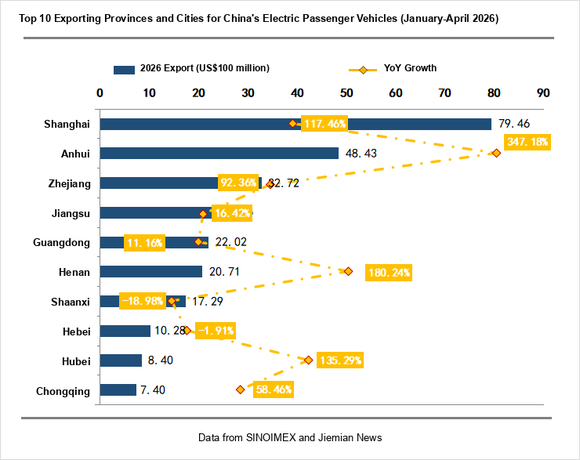
Compared with March, the April ranking was stable at the top but more competitive in the middle. Shanghai, Anhui and Zhejiang kept the first three positions, preserving the leadership of the core export cluster. Jiangxi moved into the monthly top 10, while Chongqing dropped out, suggesting that competition among second-tier export bases is becoming more fluid.
Growth disparities across provinces remained pronounced. Guangxi, Anhui, Jiangxi, Guizhou and Henan recorded the fastest year-on-year gains in April. At the other end of the ranking, Ningxia, Gansu, Shanxi, Inner Mongolia and Hainan were among the weakest performers. Fifteen provincial-level regions posted negative export growth, underscoring the widening gap between strong manufacturing bases and lagging regions.
China's EV export destination structure shifted more visibly in the first four months of 2026. Brazil overtook Belgium to become the largest destination market by value, with exports reaching US$3.29 billion, up 181.67 per cent from a year earlier. Belgium ranked second at US$3.20 billion, up 64.04 per cent, while the UK placed third at US$2.82 billion, up 91.86 per cent. The top 10 destinations together accounted for US$18.45 billion, or 60.08 per cent of total export value, keeping market concentration high.
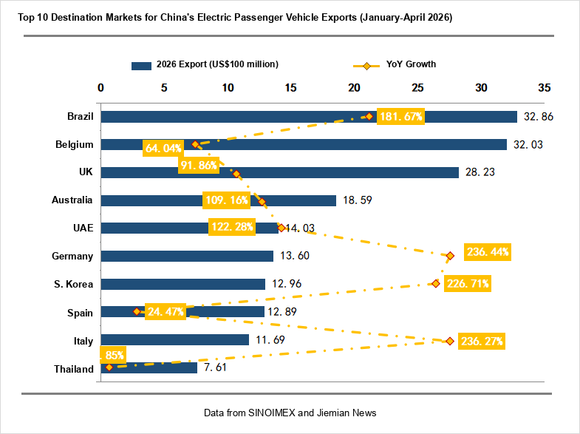
Compared with the January-March period, the top-10 list also changed in composition. Norway entered the ranking, while Thailand dropped out. At the monthly level, Uganda, Canada, Austria, Croatia and Oman recorded the fastest year-on-year growth in export value. China posted positive export growth to 100 countries and regions, while exports to 53 markets declined.
By continent, China's EV export reach expanded further in April, covering 201 countries and regions worldwide. Europe remained the largest destination region by value, with exports rising 73.97 per cent year on year to US$3.64 billion. Asia remained a stable base, with export value of US$2.64 billion, up 25.15 per cent.
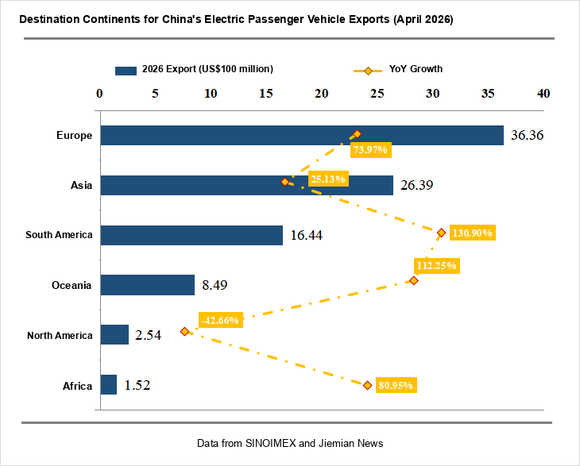
South America delivered the strongest growth momentum among major regions. Export value reached US$1.64 billion in April, up 130.93 per cent year on year, helped by Brazil's rise to the top destination spot. Oceania also more than doubled, with exports up 112.00 per cent to US$849 million, while Africa rose 81.03 per cent to US$152 million. North America was the only region to decline, with export value falling 42.61 per cent to US$254 million.
April showed that China's EV globalisation is becoming more complex and more diversified. Automakers continued to expand overseas production, build local channels, deepen technology partnerships and export smart-driving services, even as policy and market conditions diverged across regions.
Local production and overseas cooperation remained active. Great Wall Motor extended a special investment contract for local Haval production at its plant in Russia's Tula region to the end of 2033. BYD continued construction of its Szeged plant in Hungary, while its operating environment in Brazil improved after a local labour court withdrew a related determination. Chery plans to activate an acquired plant in South Africa by the end of 2027 and produce electrified models there. Geely entered Austria through local cooperation and also consolidated European R&D resources to support faster product iteration.
Market expansion also broadened. Li Auto signed partners to enter Middle Eastern markets including the UAE and Saudi Arabia, while also announcing plans for Macao, Cambodia, Laos and Myanmar. GAC Aion launched the AION UT in Europe with a Europe-oriented design and local-production strategy. Xiaomi said it would start overseas sales in 2027, with Germany as the first stop. Xpeng is exploring partnerships with overseas automakers and plans to expand overseas capacity in Europe, Southeast Asia and Latin America from 2026.
Technology cooperation and intelligent-driving exports became a clearer theme. Chery and Nvidia formed a global strategic partnership covering assisted driving, cockpit AI and embodied intelligence. Tian Tong Vision reached a cooperation agreement with a Turkish mobility platform to test and promote Chinese smart-driving chips and related products in China and Turkey. In Hong Kong, Huawei and partners signed a memorandum to support infrastructure and vehicle introduction for heavy electric trucks.
Autonomous-driving services also made progress overseas. Baidu's Apollo Go launched fully driverless commercial services in Dubai. Pony.ai started robotaxi passenger operations in Singapore and Croatia, marking a step forward for autonomous-driving commercialisation in Europe. WeRide also launched autonomous mobility services in Singapore with local partners.
The international market and policy environment remained uneven. Canada rejected a proposal related to local assembly of Chinese EVs from knockdown kits, while policy adjustments weighed on the US electric-vehicle market. At the same time, China-made EVs continued to move into mature markets in new ways, with Honda planning to introduce China-produced battery-electric models into Japan.
April's data and company developments point to a broader shift in China's EV export model. Shipment growth remains strong, but the industry's overseas footprint is no longer limited to vehicles. Production, sales channels, technology cooperation and smart-driving services are moving outward together, strengthening China's role in the global EV value chain.