China's electric passenger vehicle exports maintained strong momentum in March, with shipment volumes and export value rising both YoY and MoM.

Photo from Jiemian News
by JIA Lu
Editor's note: To provide more timely, comprehensive and accurate insights into China's electric passenger vehicle exports, Jiemian Intelligence and SINOIMEX jointly launched the China Electric Passenger Vehicle Export Monthly Report in March 2025. The report tracks monthly changes in export value, export volume and destination markets, providing reference for governments, companies and investors.
China's electric passenger vehicle trade sustained a high-growth trajectory in the first quarter of 2026, according to data compiled by Jiemian Intelligence and SINOIMEX. Total trade reached US$22.20 billion in January-March, up 80.94 per cent from a year earlier. Export value climbed 85.21 per cent to US$21.53 billion, while export volume rose 74.75 per cent to 1.13 million units, confirming that exports remained the main engine of sector growth.
March itself extended that momentum. Export value rose 69.08 per cent year on year to US$7.13 billion, while export volume increased 55.59 per cent to 376,000 units. Compared with February, export value edged up 5.38 per cent and shipments rose 1.33 per cent. The average export price reached US$18,966.32, up 8.67 per cent from a year earlier and 4.00 per cent from February, suggesting that product mix and pricing power both improved.
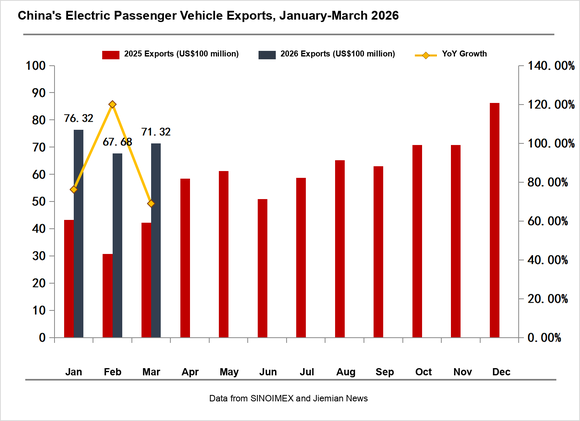
Passenger vehicles remained overwhelmingly dominant in March. They accounted for 99.66 per cent of export volume and 95.96 per cent of export value. Passenger-car export value reached US$6.84 billion, up 71.56 per cent year on year, while shipments rose 55.94 per cent to 374,800 units. Average export prices for battery-electric, plug-in hybrid and non-plug-in hybrid passenger vehicles all increased from a year earlier, rising 14.52 per cent, 1.34 per cent and 5.44 per cent respectively, indicating continued improvement in value capture across multiple powertrain categories.
Bus exports presented a more mixed picture. March bus shipments fell 21.39 per cent year on year to 1,297 units, and were down 4.77 per cent from February. But export value still rose 24.19 per cent to US$288 million as average prices jumped 57.99 per cent to US$222,157.88. Battery-electric buses remained the backbone of the category, accounting for nearly all shipments and recording a 58.87 per cent increase in average price despite lower volumes. Hybrid buses remained highly volatile from a small base, with only 10 units exported in March and average prices down 48.32 per cent.
Shanghai remained China's largest EV export source region in the first quarter, with cumulative export value of US$5.39 billion, up 143.19 per cent from a year earlier. Anhui ranked second at US$3.31 billion, surging 399.41 per cent, while Zhejiang placed third at US$2.35 billion, up 96.41 per cent. Together, the top 10 source regions accounted for 87.25 per cent of total export value, indicating that the industry remained highly concentrated geographically.
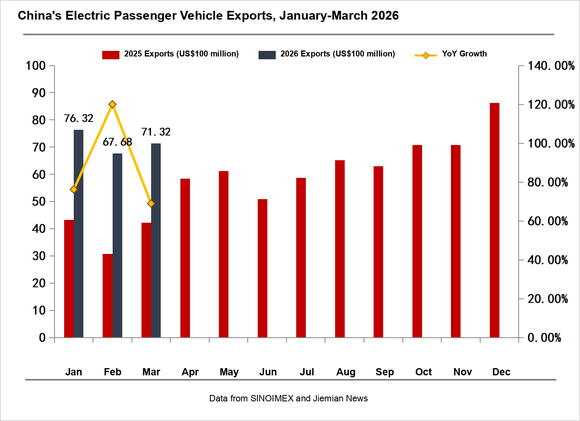
The monthly ranking shifted more visibly than in previous months. Shanghai, Anhui and Zhejiang retained the top three positions, preserving the leadership of the core export cluster. Chongqing moved into the monthly top 10, signalling growing momentum, while Jiangxi dropped out of the top tier.
Growth disparities across regions also became more pronounced. Gansu, Yunnan, Henan, Anhui and Shandong recorded the fastest year-on-year gains in March, while Shanxi, Tianjin, Hainan, Inner Mongolia and Jilin ranked among the weakest performers. Fifteen provincial-level regions posted negative export growth, highlighting a widening divide between strong manufacturing bases and lagging regions.
In January-March, Belgium remained China's largest EV export destination by value at US$2.11 billion, up 52.16 per cent from a year earlier. The UK ranked second with US$2.06 billion, up 112.96 per cent, while Brazil placed third with US$1.81 billion, surging 195.62 per cent. The top 10 destinations together accounted for US$12.61 billion, or 58.57 per cent of total export value, showing that market concentration remained relatively high.
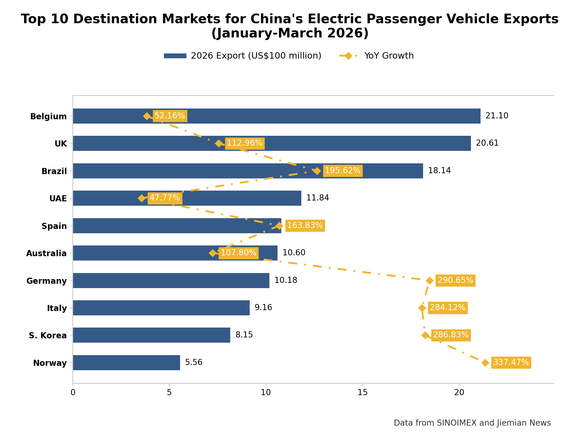
Compared with the January-February period, the membership of the top 10 destination list remained stable even though internal rankings shifted. That suggests China's core export markets are broadening gradually without a major change in the overall market map.
At the monthly level, Argentina, the Czech Republic, Austria, Serbia and Bolivia recorded the fastest year-on-year growth in export value. China posted positive export growth to 92 countries and regions, while exports to 61 markets declined.
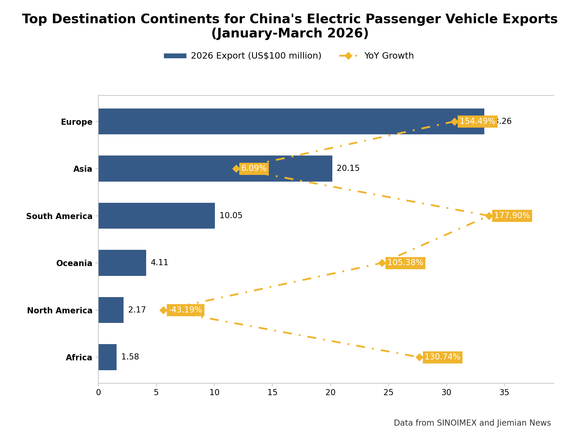
By continent, China's EV export reach continued to expand in March, covering 170 countries and regions worldwide. Europe remained the largest destination region by value, with exports rising 154.49 per cent year on year to US$3.33 billion. Asia remained the stabilising core market, with export value of US$2.01 billion, up 6.09 per cent. Africa also delivered strong growth, with exports rising 130.74 per cent to US$158 million. South America stood out as the fastest-growing region, with export value up 177.90 per cent, underlining the role of emerging markets in driving the next phase of China's EV expansion.
March showed that Chinese EV companies are responding to a more complex global trade environment with increasingly diversified international strategies. Despite continuing tariff barriers and policy uncertainty in some markets, carmakers and supply-chain players continued to deepen overseas partnerships, expand local production and broaden technology cooperation.
Honda said it would introduce China-made e:N series electric vehicles into the Japanese market, becoming the first Japanese automaker to sell Chinese-produced EVs domestically in Japan. Great Wall Motor announced an additional 10 billion baht investment in Thailand and set a target of lifting local annual sales by 40 per cent, while also expanding its Ora product lineup there. Nvidia, meanwhile, partnered with BYD, Geely and other major Chinese automakers at its GTC conference to develop Level 4 autonomous-driving vehicles based on the Nvidia DRIVE Hyperion platform.
These company moves reflect a broader industry shift. Chinese carmakers are no longer relying solely on vehicle exports, but are increasingly combining technology partnerships, local investment, reverse market entry and platform cooperation to strengthen their global footprint. According to the source report, Chinese automakers' cumulative global sales reached nearly 27 million vehicles in 2025, overtaking Japan for the first time, with six Chinese carmakers entering the global top 20 by sales.
The broader message from March is that China's EV export sector is moving into a more mature phase of global expansion. Core exporting provinces remain solid, market growth is becoming more uneven across regions, and overseas strategies are evolving from product exports toward a fuller industrial-chain presence. That combination is helping Chinese EV makers preserve momentum even in an increasingly complex global trade environment.