China's population continued to decline in 2025, while provincial capitals and megacities expanded.

Photo from Jiemian News
Shenzhen added 259,000 permanent residents in 2025, retaking the title of China's fastest-growing major city and pushing its population above 18 million for the first time.
The southern technology hub's permanent population reached 18.25 million by the end of 2025, according to local government data, putting it closer to joining China's group of 20 million-plus megacities.
Shenzhen's return to the top reflects a broader reshaping of China's demographic map. In recent years, the largest population gains had increasingly shifted toward strong provincial capitals such as Chengdu, Changsha, Hefei and Guiyang. But in 2025, growth once again tilted toward the country's biggest economic centers, especially in the Greater Bay Area.
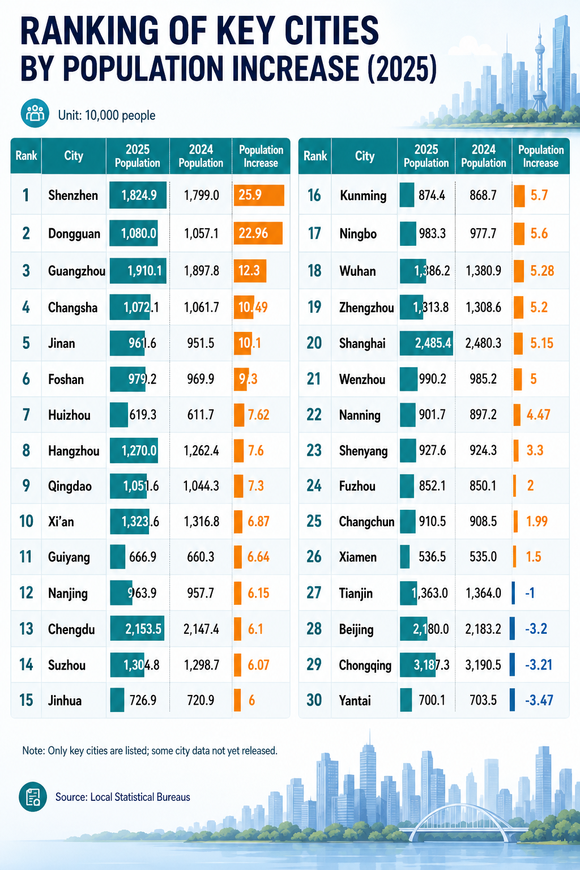
Five Guangdong cities — Shenzhen, Dongguan, Guangzhou, Foshan and Huizhou — ranked among the country's top 10 cities for population growth. Guangdong province added 790,000 residents last year, the highest increase nationwide, driven by both natural population growth and a continued inflow of migrants.
The trend highlights the enduring pull of China's high-level cities even as the country's overall population continues to shrink. China's population fell by 3.39 million in 2025, while many smaller cities and provinces recorded declines.
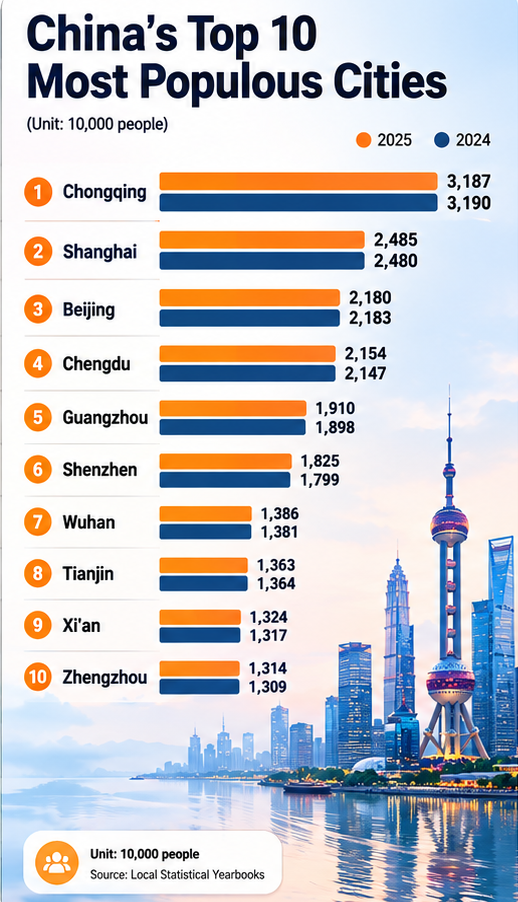
Yet major urban centers largely continued growing. The country's 10 most populous cities remained Chongqing, Shanghai, Beijing, Chengdu, Guangzhou, Shenzhen, Wuhan, Tianjin, Xi'an and Zhengzhou.
Chongqing remained in a league of its own with a population exceeding 31 million, while Shanghai, Beijing and Chengdu each had more than 20 million residents. Guangzhou and Shenzhen, with populations of 19.1 million and 18.25 million respectively, are emerging as the strongest contenders to become China's next 20 million-person cities.
Population growth is also becoming increasingly concentrated within provinces. Even where provincial populations declined sharply, capital cities often continued to attract residents.
Shandong province, for example, lost 370,000 residents overall, but both Jinan and Qingdao ranked among the country's top cities for population growth. Similar patterns appeared in central China, where provinces such as Henan and Hunan recorded large population declines while their capitals Zhengzhou and Changsha continued expanding.
Analysts say the trend reflects a familiar economic logic: people continue moving toward cities with stronger industries, more jobs and greater opportunities for upward mobility.
As infrastructure-led growth slows and smaller cities face tighter fiscal pressures, young workers are increasingly returning to major metropolitan areas in search of employment and higher incomes.
That dynamic is also reinforcing the importance of "strong provincial capitals," a policy direction many local governments now see as essential for retaining talent and competing nationally for population and investment.