AI is reshaping industries while electricity becomes more strategic, making power–computing convergence a new frontier for China's energy and digital systems.

Photo from Jiemian News
by TIAN Heqi, JIANG Xi
In a small apartment thousands of miles away, a designer taps a screen to edit a photo using AI. The command travels across oceans before landing, improbably, on the dusty Loess Plateau in northwest China.
There, rows of wind turbines turn slowly in the dry air, and vast fields of solar panels shimmer under the sun. Instead of feeding into long-distance transmission lines, much of this electricity is routed directly to nearby data centers, where tens of thousands of GPUs process requests from users half a world away.
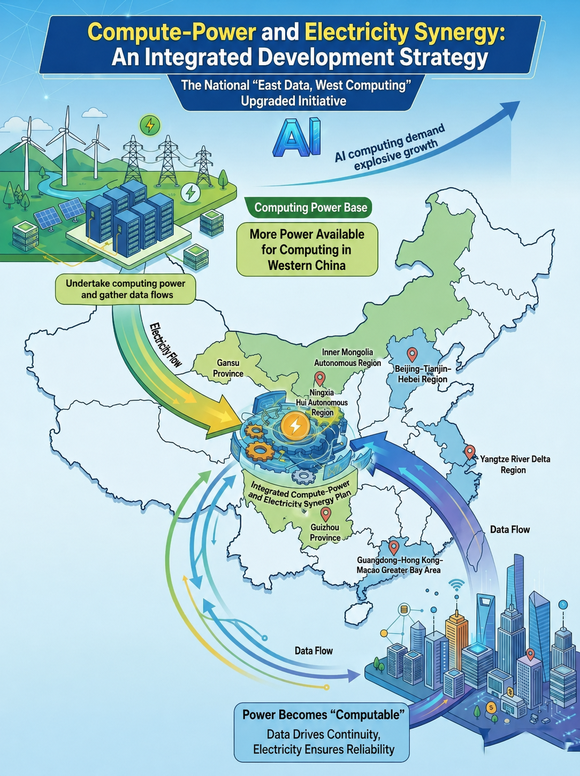
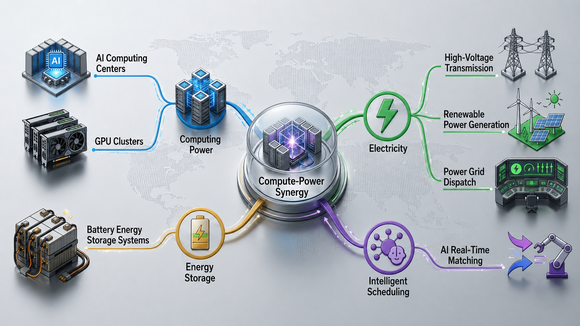
This is the emerging logic behind China's push for "compute-energy synergy" — a model that seeks to match the country's surplus renewable power with the soaring energy demands of artificial intelligence.
Nowhere illustrates that shift more clearly than Qingyang, a once-overlooked city in Gansu province, which has rapidly transformed into a key node in China's "East Data, West Computing" strategy.
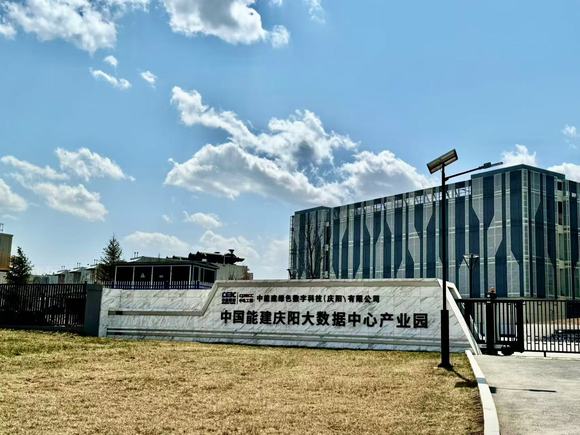
Driving into the industrial park on the outskirts of the city, clusters of newly built data centers rise from the yellow earth. Facilities operated by China Energy Engineering Group (CEEC), Kingsoft Cloud, China Telecom and Chindata Group now dot the landscape. In just a few years, Qingyang has assembled 11 data centers and computing capacity exceeding 140,000 PFLOPS, including large domestic GPU clusters.
That capacity is already being put to use. In 2025, China's cumulative token usage — a proxy for large-model computing demand — reached roughly 21.1 quadrillion, industry data show, giving rise to what some describe as a new form of "computing exports".
The policy momentum has been swift. The concept of linking computing and energy systems was written into China's government work report for the first time in March. Within weeks, multiple central agencies followed with supporting measures, while a late-April Politburo meeting placed computing networks alongside power grids in a broader national infrastructure push.
More than a dozen provincial governments have since rolled out their own plans, signalling that what began as a technical experiment is moving into a coordinated national strategy.
At its core, the idea is simple: move data to where electricity is cheapest and cleanest.
China's western regions have spent more than a decade building massive wind and solar bases, often generating more power than local grids can absorb. At the same time, coastal provinces such as Jiangsu and Guangdong remain energy-hungry. The mismatch has long led to wasted renewable output.
Artificial intelligence offers a potential solution. Unlike traditional industries, computing workloads can be relocated. Data centers can be built near energy sources, reducing transmission needs while turning electricity into higher-value digital services.
"The industry is shifting toward integrated 'green power–computing–storage' projects," said Frank Qiang Fu, a partner at Roland Berger, adding that this could reshape how energy is consumed and priced.
The economics are already visible. Electricity accounts for more than half of data centre operating costs, according to brokerage estimates, making low-cost renewable power a significant advantage. In some western regions, solar and wind generation costs have fallen to around 0.1 yuan per kWh, well below coal benchmarks.
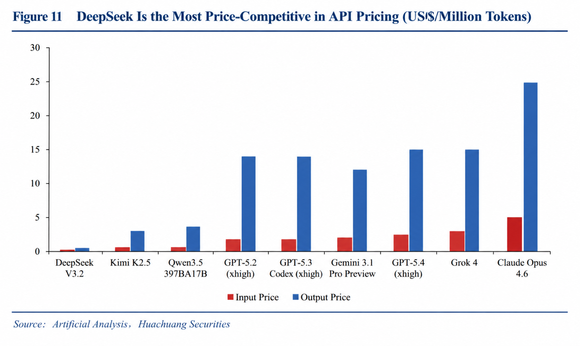
That cost edge is one reason Chinese AI models have gained traction overseas. DeepSeek, for example, charges about $0.42 per million tokens, far below the roughly $15 charged by comparable models.
Companies across the value chain are moving quickly. China Southern Power Grid Energy Development has launched systems integrating electricity, carbon and computing metrics. Storage firms such as Envision Energy and Sungrow Power Supply are developing AI-driven energy management solutions for data centers. Solar developer Jinko Power has gone further, announcing a 24.5 billion yuan investment in a computing facility in Ningxia.
Different regions are experimenting with different models. In Qingyang, developers are building high-density data centers from scratch, skipping older, less efficient designs. A Beijing-based computing firm has already established operations there, offering overseas clients access to computing power through a MaaS platform.
In eastern China, where renewable resources are more limited, companies are taking a different approach. SenseTime is using AI models to predict electricity demand and coordinate with energy storage systems, smoothing out fluctuations in supply and reducing strain on the grid.
One of the most advanced examples lies in Inner Mongolia, where Envision Energy and Tencent Cloud have built a data centre powered entirely by renewable energy. By combining weather forecasting models with energy management systems, the facility attempts to align power generation with computing demand in real time.
Such flexibility marks a break from traditional industry. Manufacturing plants typically require stable, continuous power, but data centers can shift workloads to off-peak hours, turning rigid demand into something more adaptable.
Still, the model is far from mature.
Regulatory barriers remain significant. Cross-provincial electricity trading is complex, pricing mechanisms vary, and approval processes for direct power connections are often slow. On the technical side, matching intermittent renewable generation with the stable requirements of computing infrastructure remains a challenge.
Commercial questions are equally unresolved. Long-term contracts between power producers and data centers are difficult to structure, and the costs of energy storage — critical for smoothing supply — are still high.
Even in Qingyang, practical constraints are evident. Wind and solar farms are often located more than 100 kilometers from data centers, complicating infrastructure planning. In some cases, surplus electricity cannot be sold externally, weakening project economics.
For power companies, uncertainty over future demand adds another layer of caution. "We still don't know how big computing demand will ultimately be," one industry participant said. "That makes large-scale investment difficult to justify."
Estimates underline the scale of the challenge. According to the State Grid Energy Research Institute, if China's data centers consume 800 billion kWh of electricity by 2030 — roughly 6 to 7% of national demand — the country will need an additional 120 GW of reliable power capacity, requiring more than 2 trillion yuan in investment.
For now, the vision remains a work in progress.
But the direction is clear. As artificial intelligence reshapes industries, and as electricity becomes an increasingly strategic resource, the convergence of power and computing is emerging as a new frontier — one that could redefine both China's energy system and its digital economy.
As Daniel Yergin, vice chairman of S&P Global, put it recently, the rise of AI-driven data centers is creating a "second curve" of global electricity demand.
The challenge, he suggested, is not just to generate more power, but to rethink how it is used — and where.