The dispute comes as Costco's own expansion in mainland China remains cautious.

Photo by Li Ye/Jiemian News
by ZHAO Xiaojuan, LI Ye
When a WeChat account began promoting plans for a $1.5 billion "Costco" headquarters in Beijing, complete with official-looking documents, it seemed like a long-awaited expansion by the US warehouse retailer into a key market it has yet to enter.
It was not.
Within days, the operator of Costco's existing mainland business moved to distance itself, setting off a dispute that highlights how corporate registration rules, trademark ownership and real-world operations can diverge in China's fast-moving retail landscape.
The WeChat account, run by a Beijing-based entity calling itself Costco Beijing International Commercial Development Co., claimed that an entity using the name "COSTCO WHOLESALE INTERNATIONAL, INC." would invest $1.5 billion to establish a China headquarters in the capital.
Posts said the project would target six major cities, including Beijing, Chengdu and Guangzhou, with registered capital of $100 million and a business scope covering retail, food and import-export services. The account also published notarized documents and business licenses, lending an appearance of legitimacy.
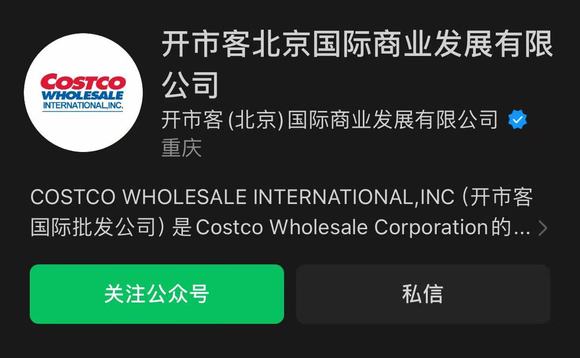
But the operator of Costco's existing mainland stores quickly pushed back.
On April 22, Costco (China) Investment Co., Ltd. told Jiemian News the WeChat account was not official, adding that its only authorized WeChat presence operates under its official Costco branding in China and is registered under its mainland entity.
Jiemian News later sent an inquiry to Costco’s US headquarters, which was referred back to the China unit.
In a follow-up response on April 23, ZHANG Guangying, supervisor and legal affairs director at Costco China, said the company has "no affiliation" with the entity referred to online as "Costco (Beijing) International Commercial Development Co." and has never authorized it to publish information under the Costco name. The company is pursuing legal action over what it described as infringement.
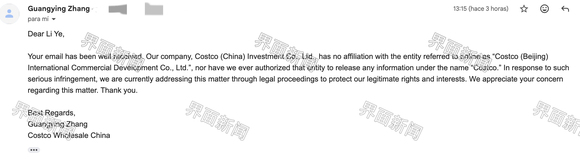
The Beijing company, however, insists it operates independently.
A staff member surnamed Zeng told Jiemian News the firm has no equity relationship with Costco China and that both sides operate separately. In a subsequent statement, the company denied any legal or commercial ties with Costco’s US parent, its Nevada-registered international arm, or the China subsidiary.
Instead, it claims to be controlled by a New York-registered company using the same name — "COSTCO WHOLESALE INTERNATIONAL, INC."
Such a structure, while unusual, is not necessarily illegal. Under US law, company names are typically regulated at the state level, meaning two unrelated entities can legally share the same name if registered in different states.
That leaves the dispute hinging on trademark rights.
The Beijing company showed Jiemian News a partial authorization document indicating that an entity identified as PRICE COSTCO INTERNATIONAL, INC. had granted trademark rights to the New York entity, COSTCO WHOLESALE INTERNATIONAL, INC. The listed address matches Costco's headquarters in Issaquah, Washington, suggesting a link to the broader corporate system.
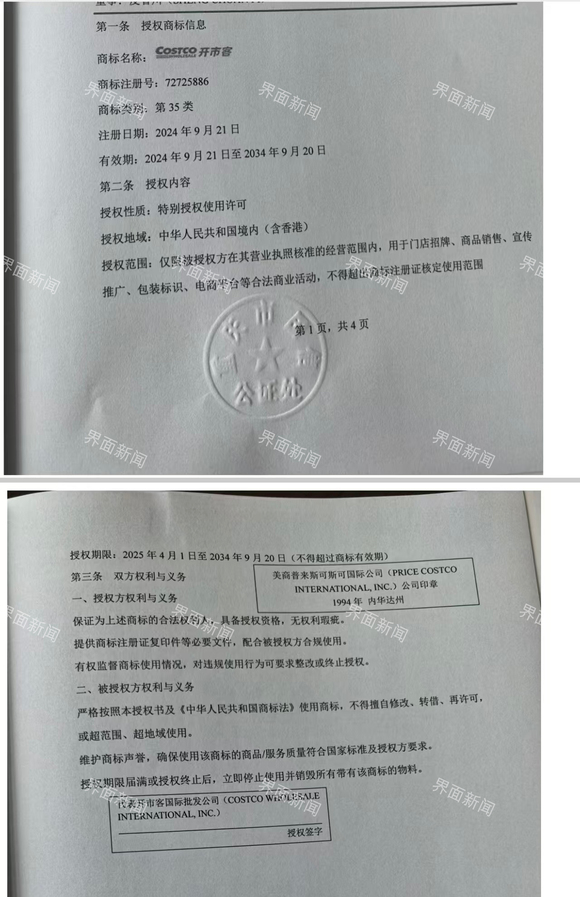
However, the document was incomplete, and its legal validity remains unclear.
Jiemian News found that PRICE COSTCO INTERNATIONAL, INC. appears in Costco's SEC filings as an affiliated entity, though it remains registered in Nevada. It is unclear whether it retains the authority to license trademarks.
Complicating matters further, US trademark records show that "Costco" and "Costco Wholesale" are currently owned by Costco Wholesale Membership, Inc., after being transferred in 2000 by Costco Wholesale Corporation.
In China, trademark filings indicate that Chinese-language "Costco" marks are held by PRICE COSTCO INTERNATIONAL, INC.
A Shanghai-based intellectual property lawyer told Jiemian News the partial documentation is insufficient to establish a valid authorization, leaving the legal position unresolved.
The episode is not without precedent.
In 2019, a company claiming to be a "Belt and Road Costco distributor" announced plans to open stores in Chongqing, only for Costco China to later deny any connection. More recently, another WeChat account claimed a Costco project in Chengdu. The Beijing entity’s account location also points to Chongqing.
The dispute comes as Costco's own expansion in mainland China remains cautious.
Since opening its first store in Shanghai in 2019, the retailer has built just seven outlets in six years, mostly concentrated in the Yangtze River Delta. Its capital-intensive model — typically involving land purchases and self-built stores — means each location can take two to three years to open.
That contrasts with rival Sam's Club, which has expanded rapidly to more than 60 stores across over 28 cities, adding several outlets each year and moving into lower-tier markets.
The Beijing company's plans target precisely those gaps.
It said it intends to build its first store in Chaoyang district, with construction expected to be completed within six months after approvals and an opening targeted between late 2027 and 2028. Beijing is notably a market Costco has yet to enter, while Sam's Club already operates multiple stores there.
The company also said it plans to benchmark its fresh food operations against a well-known domestic retailer and has recruited former executives from Walmart and Yonghui to lead strategy and operations.
On funding, it said it has secured $1.5 billion, with additional capital committed at the parent-company level and further investment planned for a second phase in China.
For now, however, those ambitions remain overshadowed by legal uncertainty.
At stake is a fundamental question: who has the right to use the Costco name in China — and whether that right can be granted to more than one operator.
Until that is resolved, China may have more than one "Costco" in name, but not in recognition.