What matters now is whether motion, manipulation and commercialization can translate into a sustainable business.

Photo from organizers of the 2026 Beijing E-Town Humanoid Robot Half Marathon
by XU Meihui, WU Yangyu, ZHOU Mo,JIN Jing
A humanoid robot has, for the first time, beaten the human half marathon benchmark — a milestone that highlights both how far the technology has advanced and how far it remains from real-world use.
At the 2026 Beijing E-Town Humanoid Robot Half Marathon on April 19, a robot named "Lightning" from HONOR Robotics, a unit of Chinese smartphone maker HONOR, clocked 50 minutes and 26 seconds, beating the human world record, according to event organizers, and slashing last year's winning time of 2 hours 40 minutes by nearly two-thirds.
The result marks a sharp improvement in performance and reflects a broader shift in how the industry is assessed — from isolated lab metrics to full-system capability in real-world conditions.
An industry investor told Jiemian News that as more companies master basic movements such as running and jumping, athletic performance is becoming a baseline. What matters now is whether motion, manipulation and commercialization can be integrated into a sustainable commercial model.
"Race times bring attention, but they don't determine valuation," the investor said.
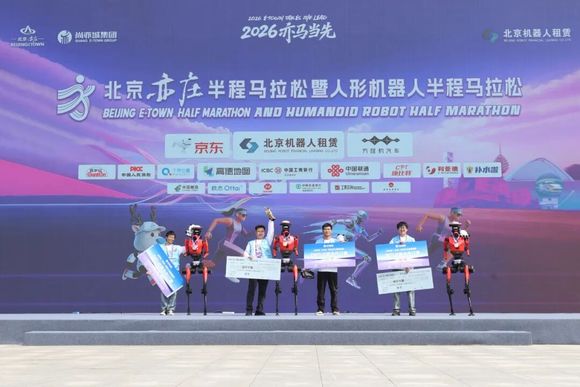
This year's race was expanded significantly in both scale and difficulty.
More than 300 robots took part, running a 21.1km course featuring slopes, narrow sections and sharp turns — including multiple near-90-degree corners — designed to test balance, perception and control. Of 102 teams, only 47 finished, a completion rate of just over 45%.
The competition also introduced separate categories for autonomous navigation and remote operation, with results weighted to favor autonomous runs over remote-controlled ones. Nearly 40% of participants competed in the autonomous group.
HONOR Robotics swept the podium, with all top three finishers running fully autonomously. Another contender, Tiangong Ultra, a robot developed by a Beijing-based research team, completed the course in 1 hour 15 minutes without human intervention, cutting its previous record significantly.
Developers attributed the gains to improved integration of hardware and software, including lidar-based localization, satellite-assisted navigation and dynamic balance algorithms. In one instance, a robot recovered from a collision and resumed running without external input.
Yet the race also exposed persistent engineering constraints.
Thermal management remains a key bottleneck. One supplier said compact joint structures create complex cooling challenges, requiring custom systems capable of dissipating over 2,000 watts of heat — even as cost pressures remain tight.
Despite the headline result, mechanical failures were common.
Many robots fell, lost balance or withdrew due to hardware damage. Analysts say this reflects a gap between lab performance and the demands of real-world deployment.
YU Yiran, managing director at consultancy CIC, said lab systems typically optimize for peak performance, while real-world applications require robustness, consistency and the ability to adapt to uncertainty.
Environmental variability — such as changing light conditions or uneven terrain — can disrupt navigation systems, while battery depletion and mechanical fatigue over long distances expose weaknesses in motion models.
Hardware durability is another constraint. Overheating joints and worn components can quickly lead to system-wide failure during sustained operation.
Supply chain capability is also emerging as a key differentiator. Larger manufacturers benefit from mature ecosystems and more reliable components, while smaller players often struggle with consistency.
Still, industry insiders caution that hardware advantages may prove temporary. As supply chains mature, competition is shifting toward integrated control systems — the coordination between perception, decision-making and movement.
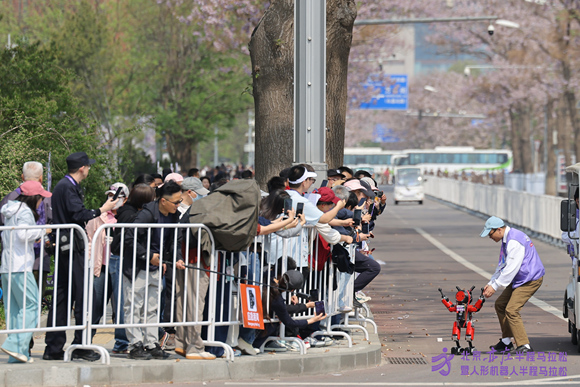
The race also highlighted different approaches to publicity and real-world use.
Some companies focused on attracting attention through design and presentation, while others used the event to test functional capabilities. Along the course, service robots handled tasks such as distributing water and supplies, demonstrating their ability to operate in complex outdoor environments.
These scenarios, participants said, test not just movement but decision-making capability — the ability to interpret and respond to unpredictable human behavior.
For investors, such demonstrations are increasingly relevant.
LI Ziyue, head of advanced manufacturing at China Renaissance, a Chinese investment bank, said strong race results can boost market visibility, but funding decisions depend on a broader set of factors, including product readiness and commercialization potential.
Investors are now focusing on whether companies can access high-quality real-world data, scale their models and generate sustainable revenue.
Debate continues over whether robot marathons are meaningful tests or little more than spectacle. But for some, they remain a necessary stress test.
"Long-distance running is essentially a test of durability and reliability — a core indicator of engineering capability," Yu said, adding that the sector may be moving from a showcase phase into a real test of its ability to deliver in practical applications.
In that sense, the next stage will be less about speed and more about turning technical capability into a viable business.