Shanghai's advantages — including its talent base, industrial diversity and global connectivity — have made it one of China's fastest-growing hubs for OPCs.

Photo from Jiemian News
by FANG Zhuoran
In a glass-walled office in Shanghai's Lingang area, entrepreneur YAO Zhenguo runs a company of three people that operates with the output of a much larger team.
Tasks that once took a finance department five hours can now be completed in 15 minutes using artificial intelligence, he said, helping it win more than 100 small and micro-sized clients.
Yao is part of a growing wave of founders in China's commercial hub building so-called "one-person companies" (OPCs) — lean ventures, often run by a single individual or a small team, that rely on AI tools to scale productivity.
Across the city, similar stories are emerging.
MING Chao, another founder based in Lingang, uses AI "digital employees" to generate content on platforms such as Xiaohongshu and Douyin, lifting customer conversion rates by about 30% compared with traditional manual methods.
In Jing'an district, LIU Yixiu has used AI to complete an entire creative project — from concept to finished product — on her own, a process that would previously have required a multi-disciplinary team.
Liu set up her studio in 2024 as a solo operation, drawn by the ability of AI tools to fill skill gaps and expand creative output.
In one project, she used AI to generate ideas, write scripts and turn visual designs into animated content, transforming a conventional cultural product into a multimedia offering.
Operating as a registered company, rather than as a freelancer, has also allowed her to take on larger clients by offering formal contracts and compliance with tax and legal requirements.
Shanghai now has close to 1,000 such companies, according to SHEN Tao, deputy secretary-general of the Shanghai AI Industry Association (SAIA), with numbers continuing to rise.
He said OPCs were becoming an increasingly dynamic part of the city's AI ecosystem, helping to fill gaps in traditional business services and speed up the adoption of new technologies.
The model has been driven in part by advances in AI agents — systems capable of carrying out tasks autonomously — allowing a single founder to coordinate multiple digital "workers".
In Shanghai, these companies are concentrated in districts such as Xuhui, Pudong, Lingang and Jing'an, where AI development is already clustered.
Local governments have moved quickly to support the trend.
Since mid-2024, districts across Shanghai have launched dedicated OPC parks, offering subsidised workspaces and business support services.
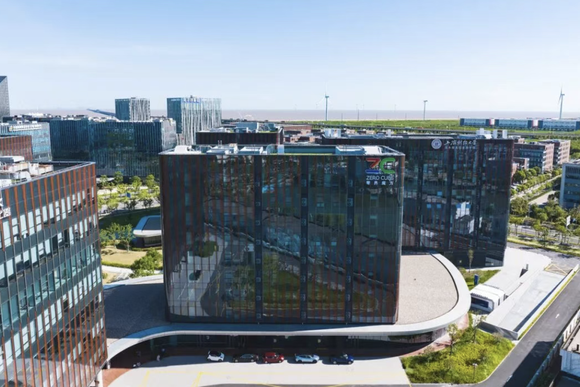
Lingjie Mofang industrial park in Lingang, for example, offers workstations starting from 90 yuan (US$13) per month, including utilities and internet access, attracting early-stage founders.
Other districts, including Pudong, Xuhui and Jing'an, have introduced similar policies, while Yangpu has launched an OPC-focused community. Tech giant Alibaba has also set up an OPC hub in Minhang.
These parks provide not only office space but also support with company registration, accounting, legal services and client connections.
Ming said he had already been introduced to potential business opportunities through park operators, underscoring the role of these spaces as more than just workspace providers.
For many founders, access to networks and resources is more valuable than direct financial support.
"OPCs depend heavily on connections, resources and rapid iteration," Shen said, adding that a supportive ecosystem mattered more than subsidies alone.
Shanghai's advantages — including its talent base, industrial diversity and global connectivity — have made it one of the fastest-growing hubs for this model in China.
In contrast, cities such as Hangzhou and Shenzhen have developed more specialised OPC ecosystems, focused on e-commerce and hardware supply chains respectively.
Shanghai's OPCs span a broader range of sectors, from AI-enabled services to manufacturing-related applications.
Industry participants expect a process of rapid turnover, with some companies failing, others scaling up into larger firms, and some collaborating to form new entities.
For Liu, the model reflects a deeper shift in how work is organised.
"AI is lowering the cost of starting a business and expanding what individuals can do," she said. "One-person companies are becoming a new way of working."