From offshore data centers to cross-border services, Shanghai is aligning infrastructure and institutions to support companies going global.

Model of a Lingang offshore data center integrating wind power with undersea computing infrastructur
by FANG Zhuoran
Shanghai is combining green digital infrastructure with cross-border service platforms to strengthen its role in global trade and data flows, as new projects in the Lingang Special Area and Hongqiao business district signal a more coordinated approach to opening up.
At the center of this push is a newly operational offshore data center in Lingang, described as the world's first to directly connect offshore wind power with an undersea computing facility. The project reflects a broader shift in how the city is building its digital economy — pairing energy supply with computing demand.
Located about 10 kilometers offshore, the facility sits 8 meters below sea level, using the ocean's natural temperature of around 15°C for cooling. This reduces the high energy and water consumption typical of land-based data centers, while drawing electricity directly from nearby wind farms to cut transmission losses.
Officials say the model — integrating power generation and computing infrastructure in the same offshore area — could improve efficiency and reliability, forming part of a wider effort to build a coordinated sea-land computing network.
The data center is designed as an edge node for international data flows, supporting services such as cross-border data processing and e-commerce settlement. With latency as low as 0.5 milliseconds, it is also positioned to handle high-intensity artificial intelligence workloads, including large model training, using lower-carbon computing power.
Beyond the project itself, Lingang is being positioned as a testing ground for China's digital opening. The area is building an international data processing hub aimed at supporting Chinese companies expanding overseas.
WANG Liang, an official with the Lingang administration, said cross-border data flows remain constrained by compliance risks and operational uncertainty, with companies often "unwilling, unable or unsure" about sharing data.
To address this, Lingang has set up a dedicated cross-border data service center offering end-to-end support, in an effort to make regulatory requirements more actionable and reduce friction for businesses.
While Lingang focuses on data infrastructure and flows, Shanghai's Hongqiao International Central Business District is building out the service layer for companies going global.
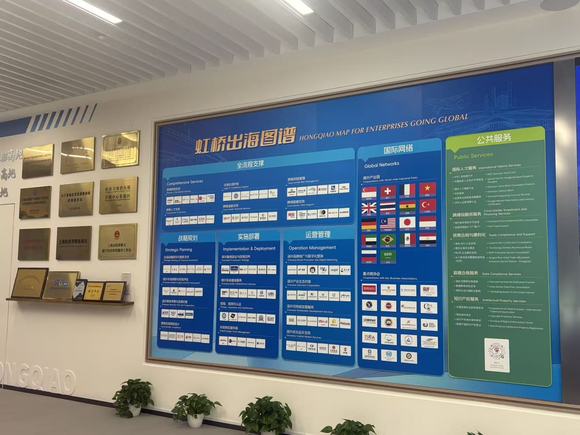
The district is positioning itself as a gateway linking domestic production with international markets, combining business services, exhibition platforms and transport connectivity. Officials describe the model as integrating "Hongqiao services, Yangtze River Delta manufacturing, and global markets."
As of 2025, the district hosts 283 municipal-level headquarters, with annual revenue reaching 280 billion yuan. It has also leveraged the spillover effects of the China International Import Expo to build year-round trade platforms and an online marketplace to extend exhibition activity.
Around 24,000 technology service firms are based in the area, forming a support network covering the full innovation chain — from consulting to commercialization — for companies expanding abroad.
Professional services providers are also scaling up their role. The Hongqiao-based KAMPUS center operated by KPMG China provides audit, consulting and risk management services for cross-border operations, while introducing AI-powered tools to streamline workflows.
The firm said its global China business network spans more than 60 destinations, helping companies reduce transaction costs as they expand internationally.
The dual focus on infrastructure and services reflects a broader shift in Shanghai's opening strategy — from attracting inbound investment to enabling outbound growth.
In 2025, the city's GDP reached 5.67 trillion yuan, while total financial market turnover rose to 4,059 trillion yuan. Trade totaled 4.51 trillion yuan, and the Port of Shanghai retained its position as the world's busiest container port for a 16th consecutive year.
Taken together, the developments point to a more integrated approach: pairing green computing capacity with institutional support, as Shanghai positions itself as a hub for both global data flows and outbound Chinese businesses.