The Middle East has been a key destination for Chinese firms seeking overseas growth.

Photo from Jiemian News
by LI Ye
As conflict flares again in the Middle East, the shock is being felt far beyond the battlefield — in warehouses, ports and shop floors where Chinese businesses are struggling to keep goods moving.
On April 8, Israeli airstrikes in southern Lebanon and renewed strains between the United States and Iran put a fragile ceasefire under pressure, raising concerns over regional shipping security. Shipping through the Strait of Hormuz remains highly restricted despite the ceasefire, with traffic running at a fraction of normal levels and vessels queuing to pass, according to shipping data and media reports. The waterway handles roughly a fifth of global oil shipments, making any disruption a key concern for global markets.
For companies operating in the region, the disruption is no longer abstract.
In the United Arab Emirates and Saudi Arabia, businesses say operations have slowed or paused, with employees working remotely and shipments delayed. Hotel prices in some cities have fallen sharply, while imported food has become both scarcer and more expensive. In some cases, everyday items have turned into luxury purchases — slices of watermelon selling for as much as 120 yuan (US$17.5) amid supply shortages, according to people familiar with local conditions.
The Middle East has been a key destination for Chinese firms seeking overseas growth. Data from the Dubai Chamber of Commerce shows the number of newly registered Chinese companies rose by about 20% to 25% year-on-year in 2024, with the total exceeding 10,000 by early 2026. In Saudi Arabia, investment licenses issued to Chinese firms more than doubled in 2024, with nearly 2,000 entities registered by the end of 2025.
That expansion is now colliding with a sudden breakdown in logistics.
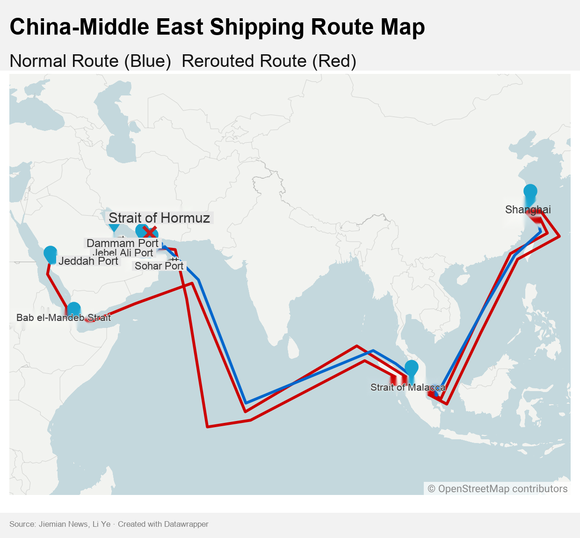
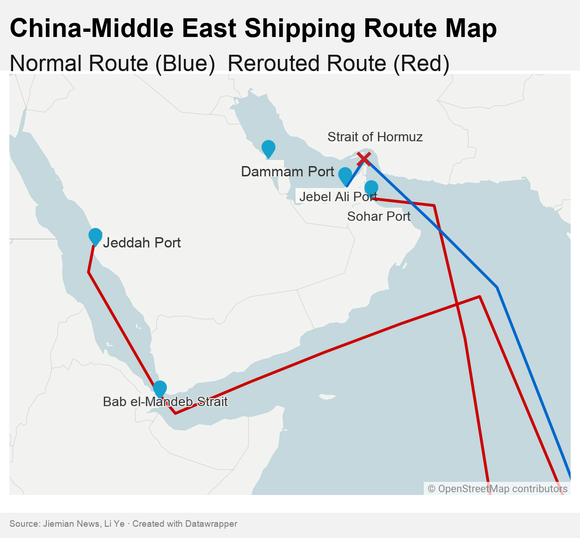
The traditional shipping route linking China to Gulf ports — including Jebel Ali, Abu Dhabi and Dammam — has been severely disrupted, forcing cargo to take longer and costlier detours. Shipments to Saudi Arabia are now routed through the Bab el-Mandeb Strait into the Red Sea before entering via Jeddah Port, while cargo bound for the UAE is diverted through Sohar Port in Oman or Khor Fakkan Port.
The added distance has driven up costs across the board. Sea freight to Saudi Arabia has risen about 40%, while UAE-bound shipments have surged by around 130%. Air freight costs have also climbed, increasing about 40% for Saudi Arabia and 35% for the UAE, according to people in the logistics sector.
"Right now the biggest problem is that goods simply cannot arrive," said a China-based freight manager who serves clients shipping to the Gulf.
Operations near coastal and military areas have largely stalled, though inland distribution networks continue to function with delays.
For traders, the uncertainty is forcing difficult choices. One Chinese entrepreneur who sells discounted electronics to Iraq said shipments are being rerouted to avoid the Strait of Hormuz, pushing shipping costs to more than double previous levels.
The business relies on buying returned or unsold electronics at low cost and reselling them in Middle Eastern markets, where demand for affordable devices remains strong. Before the latest escalation, one of his clients was placing orders worth about 5 million yuan a month, he said.
Now, those orders have shrunk.
"Customers are worried prices will rise if goods run short, but they're also afraid they won't be able to sell inventory if demand drops," he said. "So they are ordering in smaller batches, more frequently."
Freight companies say less-than-container-load shipments have fallen by about 30% since the conflict escalated, as businesses adopt a wait-and-see approach.
Large projects are also being affected. A Chinese contractor involved in Saudi Arabia's NEOM development said work on part of the project has been suspended, delaying construction timelines.
The slowdown is visible beyond logistics. Marketing campaigns have largely been put on hold, as consumer demand weakens.
"There is little point in promotions right now," said a regional executive at a Chinese business association. "People are focused on essentials — and even then, they buy whatever is available."
With expatriates accounting for roughly 80% of the UAE's population, any escalation that prompts departures could further erode demand.
For companies, the risks extend beyond supply chains. Executives warn of potential losses from unpaid prepayments, deteriorating customer credit profiles and falling asset values for offices and warehouses purchased before the conflict.
Some Chinese firms have already begun tightening procurement, cutting costs and adjusting pricing strategies to preserve cash flow.
Yet few are ready to walk away.
Past crises in the region — from financial shocks to the Covid-19 pandemic — have often been followed by rapid recoveries, with reconstruction bringing new opportunities.
"Cash flow is the most important thing right now," the trader said. "The market for essential goods never disappears. When the conflict ends, demand will come back — and that's when the opportunity starts."