Annual sales in China have fallen for seven straight years.

Photo from Nissan
by GE Cheng
On Aug 26, 2025, the last Nissan R35 GT-R rolled off the line at the company's Tochigi plant in Japan, ending an 18-year production run of about 48,000 units. The retirement of the model comes as Nissan Motor faces a far more immediate challenge in China, where its sales and relevance have eroded rapidly in the shift to electric vehicles.
The GT-R's lineage dates back to 1969, when the original Skyline GT-R notched up 50 consecutive race wins. Its modern revival came in 2007 under then chief executive Carlos Ghosn, when the standalone R35 recorded a Nürburgring lap time of 7 minutes 29.03 seconds — a high point that now contrasts with the company's current predicament.
In China, Nissan's decline has accelerated. Annual sales have fallen for seven straight years, dropping from a peak of 1.56 million vehicles in 2018 to 794,000 in 2023, and further to 653,000 in 2025, wiping out nearly 60% of its market share from the peak.
The financial toll has been severe. For the fiscal year ending March 2025, Nissan reported a net loss of 670.9 billion yen, its worst result in more than two decades, and has forecast another loss of 650 billion yen for the current year.
Weak demand has also hit its retail network, with dealership closures and downsizing reported in major cities as falling prices and thinning customer traffic squeezed margins.
Industry analysts say the pressure reflects a broader structural shift. Joint-venture brands have relied on price cuts to defend volumes, eroding profitability, while the rapid rise of new-energy vehicles has undermined the pricing power and product appeal of traditional petrol models.
The China slowdown mirrors Nissan's global challenges. The company sold 3.35 million vehicles worldwide in 2024, down nearly 40% from a decade earlier. A failed merger with Honda Motor has further highlighted concerns over cash flow and debt.
Even so, China remains central to Nissan's future. While North America has overtaken it as the company's largest market by volume, China's faster pace of electrification means its trajectory there will shape its global competitiveness.
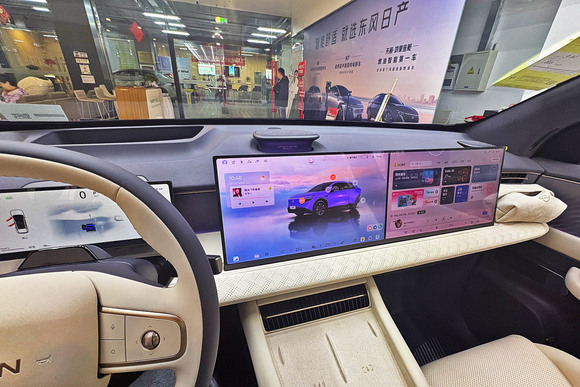
The company has begun to respond. Since April 2025, it has rolled out a series of new models in China, including an updated Teana, the fully electric N7 and plug-in hybrid N6, with the NX8 sport utility vehicle due in April 2026. Sales staff say these launches are critical to stabilizing the business.
In March 2026, Nissan (China) Investment appointed LIU Xinyu as its first Chinese general manager, effective April 1, breaking with a long-standing practice of Japanese leadership. Liu previously led Dongfeng Nissan's sales arm and is credited with pushing electric transition and channel reforms.
The move reflects a wider shift among foreign carmakers towards localization in China. However, industry observers note that while local executives may improve execution, key decisions often remain with headquarters.
Nissan's deeper problem is structural. Its China sales are still heavily reliant on petrol models such as the Sylphy, Qashqai and Teana, which together accounted for more than 80% of Dongfeng Nissan's volume in 2025.
Although newer models such as the N6 have gained some traction, the company remains behind Chinese rivals in both scale and profitability in electric vehicles.
The competitive gap is widening. China's new-energy vehicle sales reached 16.49 million units in 2025, up 28.2%, with local brands taking 69.5% of the passenger vehicle market.
Nissan plans to launch 10 new-energy models in China by 2027, but the window to catch up is narrowing.
The end of the GT-R marks the close of a defining chapter for Nissan. Whether the company can regain ground in China will depend less on nostalgia and more on how far it is willing to change.