"Chinese companies can no longer just 'go global' — they must become truly global."

Photo from Jiemian News
by MA Yueran, JIANG Xi
"Now is a window of opportunity," said ZHANG Chuanwei, chairman of Mingyang Smart Energy Group Co., Ltd. (Mingyang).
Rising energy demand and growing concerns over supply security are driving demand for renewable energy, which is increasingly seen not just as a climate solution but also as a key solution for energy security — creating strong demand for Chinese equipment and solutions overseas.
Mingyang, a major Chinese offshore wind turbine maker, ranked the world's third-largest manufacturer by market share in 2025, according to BloombergNEF.
Zhang made the remarks in an interview with Jiemian News on the sidelines of the Boao Forum for Asia Annual Conference, as Chinese renewable energy companies accelerate overseas expansion amid intensifying domestic competition and mounting trade barriers abroad.
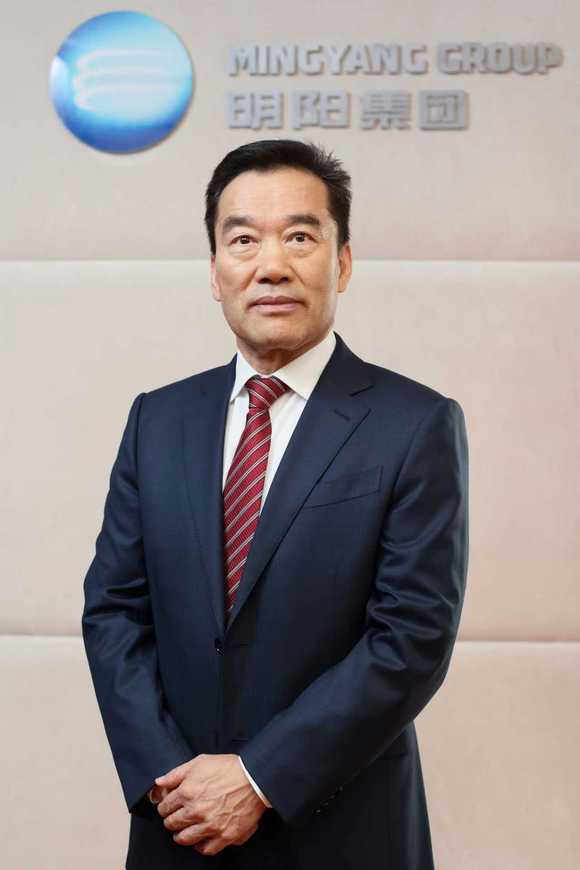
He is set to travel to Ethiopia to advance local projects and explore building an industrial cluster, before heading to Europe next month as part of a broader overseas push.
Zhang identified Europe as a key target market. He said he had recently met executives from Fortune 500 companies during the China Development Forum in Beijing and aims to bring China's deep-sea offshore wind technology there.
Energy constraints are emerging as a key constraint on data center expansion, shaping both costs and deployment speed. In markets such as Europe and the United States, a mix of wind, solar, storage and gas could help meet rising demand.
"Future demand for China's new energy equipment and solutions will be very strong," he said.
Despite tariffs and trade investigations in Western markets, exports of Chinese solar, wind and energy storage equipment have continued to surge — a trend Zhang said "cannot be reversed".
He said offshore wind costs could fall by as much as 40% within three years, potentially bringing power prices down to around 1 yuan per kWh (about US$0.14).
Trade barriers and geopolitics are also reshaping how Chinese companies expand abroad.
Zhang said firms are moving away from export-led models toward local production, as overseas markets increasingly require domestic manufacturing and supply chains.
"Chinese companies can no longer just 'go global' — they must become truly global," he said, adding that localization will be critical to the next phase of expansion.
Speed of execution will determine winners, he said, as companies race to establish local operations and deliver integrated solutions.
Southeast Asia remains the most immediate growth market, with policy shifts in Vietnam and renewed momentum in the Philippines. The Middle East — including Saudi Arabia and the United Arab Emirates — is also pushing ahead with gigawatt-scale wind projects, while opportunities are expanding across Africa, Central Asia and eastern Europe.
"The market is huge," Zhang said.
China produces more than two-thirds of the world's wind turbines and about 70% of key components, making it the largest manufacturing base globally.
Yet wind exports lag behind solar and batteries, reflecting the sector's complexity. Turbines are large, site-specific installations that require heavy transport, local construction capacity and long project cycles. In some markets, infrastructure gaps and the lack of technical standards add further costs.
Projects also depend on wind resources, grid access and long-term operations — raising barriers to overseas expansion.
Zhang said technologies such as artificial intelligence, robotics, drones and autonomous vessels will be key to improving efficiency.
For Chinese renewable companies, the opportunity is clear — but competition will hinge on how quickly they can localize and scale.