Higher margins overseas are proving harder to achieve.

Photo from Jiemian News
by GAO Jing
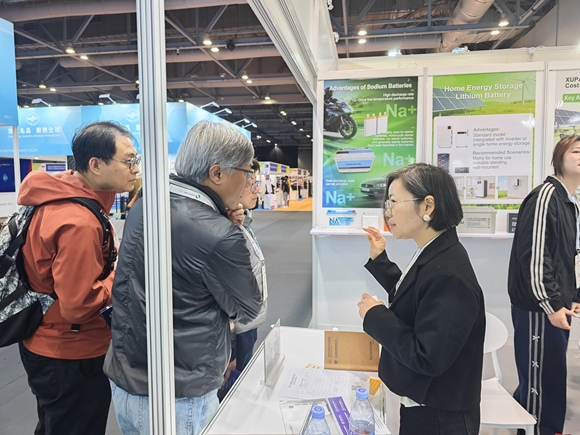
On a busy afternoon at a battery expo in Hong Kong, CHEN Feiying barely has time to sit down.
The export director at Paineng Energy (Changxing) Co., Ltd. moves between back-to-back meetings, pausing only briefly before being pulled away by overseas visitors crowding her company's booth.
Her schedule reflects a broader shift across China's battery industry: as margins shrink at home, companies are increasingly looking overseas for growth.
At the 2026 Battery Show Asia (TBSA), held from March 10 to 12 at AsiaWorld-Expo, about 350 exhibitors and more than 20,000 professional visitors attended, with 65 % from overseas — underscoring strong global demand.
For newer players such as Paineng Energy, founded in 2024, the exhibition offers direct access to overseas buyers. The company produces lead-acid, lithium-ion and sodium-ion batteries, with sodium-ion products drawing the most attention.
Chen said the interest is driven in part by the technology's novelty. Compared with lithium-ion batteries, sodium-ion alternatives offer lower costs — potentially 30 to 40% cheaper — as well as faster charging and more abundant raw materials, though they lag in energy density.
They may also gain traction overseas, particularly in Europe, where carbon footprint standards favor lower-impact technologies.
Industry data cited by GGII show that sodium and iron in such batteries can achieve recycling rates above 95%, higher than lithium, cobalt and nickel in lithium-ion batteries.
For now, sodium batteries are mainly used in starter applications, but Chen expects them to expand into power and energy storage. The company hopes the technology can eventually replace lead-acid batteries as its main export product, amid intense price competition.
Across the exhibition hall, larger players are also stepping up their overseas push.
BTR New Material Group Co., Ltd. (920185.BJ), a leading anode materials supplier, used the event to launch two fast-charging graphite products for global markets. The products, based on both artificial and natural graphite, can support 6C fast charging, enabling a full charge in about 10 minutes.
The Hong Kong debut is part of a broader push to raise its global profile. BTR began operating an Indonesian production base in 2024 with annual capacity of 160,000 tonnes and holds an estimated 25 to 27% share of the global anode materials market.
John H. Kwon, global general counsel at CATL (300750.SZ), said at the TBSA summit that Chinese battery companies must expand overseas to survive.
China's domestic battery market has become saturated, he said, as low prices and thin margins push companies to expand overseas.
Yet higher margins overseas are proving harder to realize.
A BTR representative said companies need to rethink assumptions about overseas customers' price sensitivity, as joint ventures expand and pricing becomes more transparent, narrowing the gap between domestic and overseas prices.
At the booth of REPT Battero Energy Co., Ltd. (00666.HK), Southeast Asian buyers gathered in large numbers.
The company has expanded its global footprint, setting up subsidiaries in Germany and the United States and launching construction of its first overseas manufacturing base in Indonesia in 2025, with support from its parent, Tsingshan Holding Group.
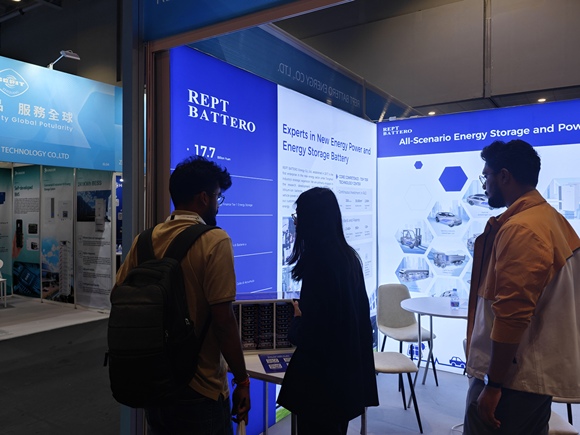
Southeast Asia is emerging as a fast-growing energy storage market, driven by policy support and relatively weak power infrastructure, though customers remain highly price sensitive.
"In some regions, target prices are even lower than in China," a regional sales manager said.
Further down the value chain, charging infrastructure providers face a different set of challenges.
WANG Bing, general manager of the park business unit at Teld New Energy Co., Ltd., said overseas equipment prices can be roughly double those in China, but additional costs — including certification, compliance and maintenance — can erode those gains.
As a result, the company is focusing on exporting integrated systems, from equipment and platforms to services and production lines.
"If we cannot provide a full system in a market, we would rather withdraw," Wang said.
For many companies at the expo, the move overseas is both necessary and uncertain.
Margins are under pressure, competition is intensifying, and local markets bring regulatory and cultural challenges, but companies see global expansion as their only path forward.
Back at the booth, Chen is already preparing for the next round of meetings.
Interest in sodium-ion batteries may not translate into immediate orders, she said, but the direction is clear.
"As long as product quality holds up, we are confident we can sell it overseas."