For years, Chinese companies travelled to the US to showcase products and seek funding in Silicon Valley. Now the flow is beginning to reverse.

Photo from AWE
by CHENG Lu
When Atuwatse stepped into the Shanghai Eastern Hub International Business Cooperation Zone, he was still jet-lagged from the flight. Within an hour, robot dogs were climbing stairs, humanoid machines resembling Transformers were drawing crowds — and he had found the hardware supply chain that had brought him to China.
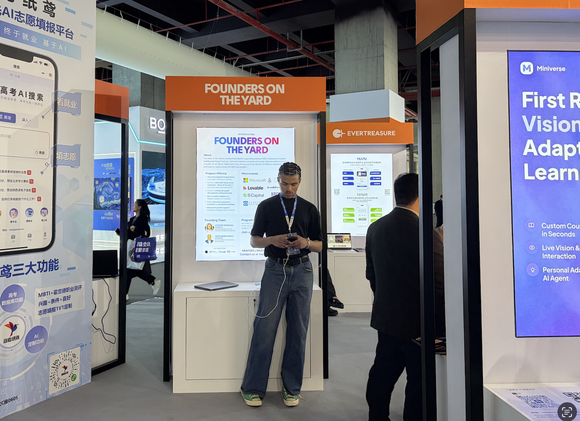
Atuwatse is a co-founder of Founders On The Yard, an accelerator supporting founders from historically Black colleges and universities (HBCUs). He was among overseas entrepreneurs attending the 2026 Appliance & Electronics World Expo (AWE), one of Asia's largest consumer electronics and home appliance trade shows.
The expo opened in Shanghai on March 12, with more than 1,200 exhibitors across 170,000 square meters. One group stood out this year: a delegation of 15 startups from Silicon Valley and other global tech hubs appearing together at a Chinese trade show for the first time.
For years, Chinese companies travelled to the US to showcase products and seek funding in Silicon Valley. Now the flow is beginning to reverse.
The delegation was organized by SVTR (Silicon Valley Tech Review), an AI-focused venture platform. Founder LIU Min said interest far exceeded expectations.
"More than 1,000 companies applied," Liu said. "After three rounds of screening, we selected 15 to come to Shanghai. The whole process took about a month."
Each startup came to Shanghai with a clear goal: to find manufacturing partners, tap China's supply chains or enter the Chinese market.
Founders On The Yard was among them. Atuwatse said one startup in the accelerator is developing software that automates printed circuit board (PCB) design to help speed up development cycles for robotics and other hardware products.
He said many traditional companies were investing heavily in robotics and that the team wanted to see whether its tools could help shorten the design process.
Another company in the delegation, Cephia, develops compact spectral chips using metasurface technology and is exploring manufacturing partnerships in China.
Producing such components requires specialized fabrication capabilities that remain difficult to replicate outside China. China accounts for much of the world's electronics manufacturing and has built one of the most comprehensive hardware supply chains.
"For anything involving hardware, China is still the first choice," Liu said. "That is especially true in robotics. Once manufacturing becomes part of the picture, companies inevitably turn to China's supply chain."
The trend was already visible earlier this year at the Consumer Electronics Show (CES) in Las Vegas, where Chinese hardware companies drew significant attention. Behind that rise is a manufacturing ecosystem built for rapid iteration and supported by deep networks of component suppliers.
This year's AWE also adopted a new format to lower barriers for overseas participants. The event introduced a "dual-venue" model, adding the Shanghai Eastern Hub International Business Cooperation Zone, a new area aimed at facilitating international trade and technology exchange.
Within the zone, exhibition goods can enter duty-free, while foreign visitors with registered invitations can enter visa-free and stay for up to 30 days. The policy has helped draw more overseas entrepreneurs, investors and buyers.
Beyond the exhibition itself, the visiting startups will spend the coming days visiting Chinese technology companies, attending supply-chain forums and investment meetings, and touring manufacturing hubs across the Yangtze River Delta.
Another participating company, ProsGrow AI, develops an AI platform for trade shows and conferences that helps exhibitors connect with potential buyers and partners.
Its founder said the company's approach reflects broader changes in global business. In recent years, Chinese consumer tech companies — from short-video platforms to smart appliance makers — have expanded rapidly overseas and proved increasingly competitive in global markets.
The founder said technology could help bridge physical distance in a globalized world.
Liu said the US still leads in technological innovation and venture capital, but China retains a decisive advantage in manufacturing.
"Any company with global ambitions cannot afford to ignore the Chinese market," he said. "And if you're building hardware, it's very hard to do it without China's supply chain."
For many startups, the trip underscores a broader shift in the global tech landscape. As artificial intelligence moves into physical devices, the ability to rapidly prototype and manufacture hardware is becoming a decisive advantage — one that continues to draw startups and founders to China.