Seedance 2.0 is available only in mainland China during testing.

Photo from Jiemian News
by LU Pengpeng
Cats pummelling Godzilla. Ip Man fighting Iron Man. Sun Wukong facing Ultraman. A schoolboy dunking on LeBron James.
Clips like these, generated by ByteDance's video-generation model Seedance 2.0, have spread rapidly across social media platforms outside China, prompting foreign users to seek access.
Some online users claim they have made more than US$8,000 in two days by selling accounts and usage credits for Chinese apps hosting the model.
Seedance 2.0 is in closed beta on domestic platforms including Jimeng, ByteDance's AI content creation app, and Doubao, the company's chatbot and generative AI assistant. The system accepts text, image, audio and video inputs, enabling multi-shot videos with native soundtracks in under a minute. The tool lowers the barriers to professional video production.
Demonstration videos have circulated widely beyond China, with several surpassing one million views. Commenters have described the visuals as "Hollywood-level" and praised the smooth motion. Chinese game producer Feng Ji called it "the strongest video generation model on the planet", while video creator Tim from Filmmaker Hurricane said it could "change the video industry".
Users on platforms such as X and YouTube have experimented with fantasy scenarios such as Wukong facing Marvel superheroes or pets dunking on NBA stars.

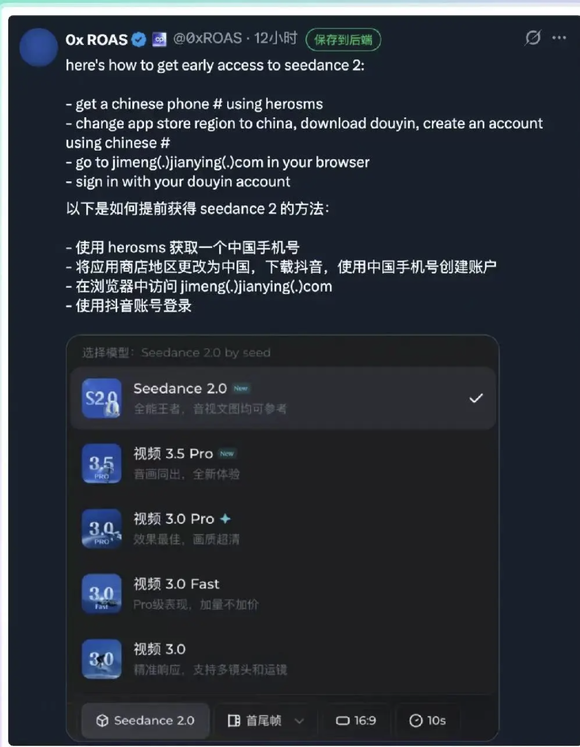
Seedance 2.0 is available only in mainland China during testing. The restriction has prompted users to share guides on how to download Chinese apps and bypass access barriers. Social media posts frequently ask whether there is an international version or a reliable way to join the beta.
The demand has also created a secondary market. On platforms such as Jimeng, generating videos consumes credits that are limited initially and must be replenished through paid memberships. Sellers have begun offering credit top-ups or fully registered accounts. In online communities, some users say they are willing to pay a premium because official access remains limited.
Some Chinese commentators have described the rush to try the model outside China as a form of technological "reverse export". The Global Times, a state-backed Chinese tabloid, wrote that the industry is entering an era in which "one person can make a film", reflecting confidence in China's AI capabilities.
From OpenAI's Sora to ByteDance's Seedance 2.0, competition in AI video generation is intensifying. Interest in the model beyond China highlights the growing global visibility of Chinese AI developers.
For now, its global reach is driven by viral videos rather than an official international rollout.