Industry executives and researchers expect invasive BCIs to gain traction in serious medical settings over the next three to five years.

Photo from Jiemian News
by XU Meihui
China has completed its first clinical trial of a fully implanted, fully wireless, battery-powered brain-computer interface, pushing the technology beyond laboratory demonstrations toward routine clinical use.
At the 2025 Brain-Computer Interface (BCI) and Artificial Intelligence Forum hosted by the Tianqiao and Chrissy Chen Institute (TCCI), NeuroXess, a China-based BCI developer, said its system is the country's first of its kind and only the second globally to integrate an internal battery.
The device was implanted in a 28-year-old patient with a high-level spinal cord injury who had been paralyzed below the shoulders for eight years. The patient was transferred from post-operative care to a general ward one day after surgery. Within five days, following initial activation and training, the patient was able to control a computer cursor using thought alone and later operate a wheelchair and robotic arm via neural signals.
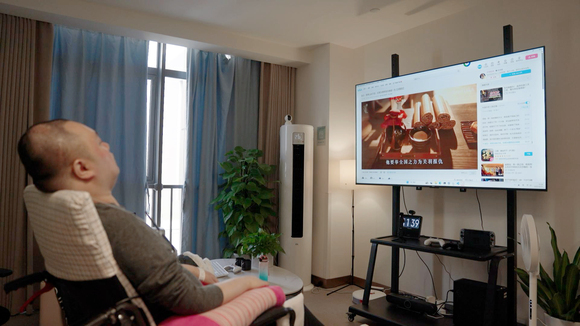
TAO Hu, founder and chief scientist of NeuroXess, said all core modules, including the battery, are implanted inside the body, with no external cables or ports. That design, he said, removes a major infection risk associated with earlier exposed systems.
The battery is placed subcutaneously in the chest, similar to deep brain stimulation architectures, moving heat-generating components away from the brain and improving long-term safety, Tao said. The system supports wireless power and wireless data transmission, allowing untethered daily use.
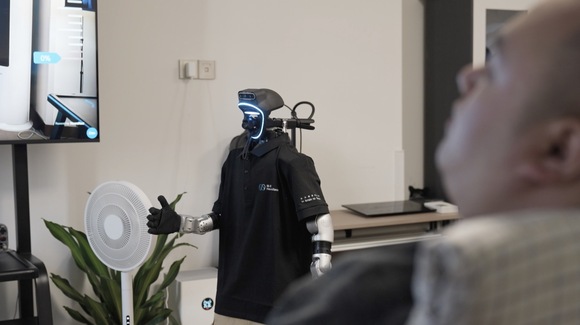
Powered by NeuroXess' proprietary operating system, XessOS, the platform enables thought-based control of screens and can connect to wheelchairs, robotic prosthetics, smart home systems and AI-driven humanoid robots.
In standardized tests, the patient achieved a neural decoding rate of 5.2 bits per second, close to leading international levels. At that speed, users can select dozens of characters or commands per minute using thought alone.
Beyond motor control, the company is also advancing language decoding. Tao said that while natural speech averages about 150 words per minute, combining BCIs with AI models could eventually allow patients to communicate at roughly 300 words per minute.
NeuroXess' approach differs from that of Neuralink, founded by Elon Musk. Neuralink focuses on inserting sensors deep into a limited number of neural pathways to capture highly precise signals, while NeuroXess deploys sensors across multiple cortical areas to broaden signal coverage. The former prioritizes depth and precision; the latter emphasizes coverage, safety and long-term usability.
Following the initial success, NeuroXess is accelerating its push toward commercialization. Tao told Jiemian News that the company has conducted 54 early-stage, exploratory BCI clinical cases across multiple regions in China, primarily focused on research and system iteration. Based on these results, it plans to launch multicenter registration trials, a key step toward formal medical device approval.
The milestone shifts attention from experimental performance to practical questions of scale, including whether such systems can be integrated into hospital workflows, approved by regulators and supported by viable payment models.
Commercial hurdles remain. "If a product cannot offer a clear, irreplaceable advantage, it will not be commercially viable," Tao said, noting that heavy R&D investment demands a clear edge over existing alternatives.
Industry executives and researchers say non-invasive BCIs are likely to commercialize first in non-critical applications such as health monitoring and rehabilitation, while invasive systems may gain traction in serious medical settings over the next three to five years. Over a longer horizon, they say, high-throughput BCIs could enable deeper integration between artificial and human intelligence, with significant market potential.