LandSpace's board secretary Zhang Yujiao said the company aims to cut launch costs to under 20,000 yuan per kilogram.

Photo from LandSpace
by MA Yueran
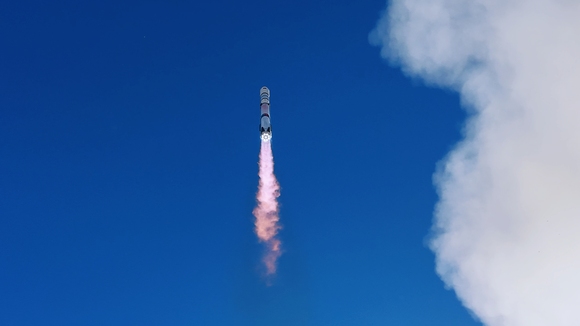
LandSpace's Zhuque‑3 rocket reached orbit on its maiden flight on December 3, but the missed first‑stage landing marked a setback in China's bid to develop reusable orbital launchers that could eventually rival SpaceX's cost‑efficient, high‑frequency model.
The Zhuque‑3 Y1 lifted off from the Dongfeng Commercial Space Innovation Pilot Zone and the second stage entered its planned orbit, the company said. The booster attempted a controlled, engine-powered descent using grid fins and deployable landing legs, but an "abnormal combustion event" during its return prevented a soft landing at the downrange recovery site.
LandSpace said the mission still confirmed the launcher's overall design and provided key flight data across propulsion, guidance and structural systems. Engineers are examining the anomaly as the company prepares for subsequent reusability attempts.
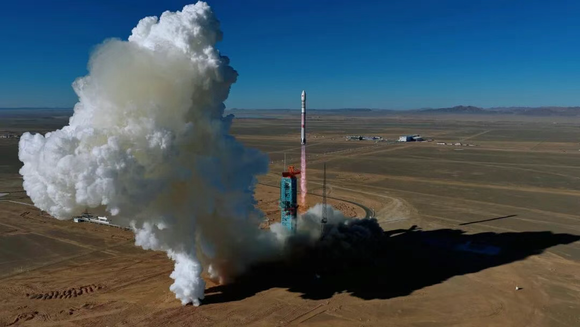
Zhuque‑3, a stainless‑steel, two‑stage methalox launcher, is designed for up to 20 reuses, according to the company. Powered by nine Tianque‑12A engines, it generates more than 750 tonnes of liftoff thrust and can deliver 21.3 tonnes to low Earth orbit in expendable mode—approaching Falcon 9–class capacity while aiming for lower refurbishment costs. LandSpace's earlier Zhuque‑2 carries up to 6 tonnes.
A LandSpace representative told Jiemian News that the main challenge in the inaugural recovery attempt was coordinating guidance across launch‑site, airspace and landing‑zone tracking systems. "The booster's return path requires continuous in‑flight adjustments to guide it hundreds of kilometers back to a precise landing point," the representative said.
If future tests succeed, Zhuque‑3 could make China the second nation after the United States to field reusable liquid‑fuel orbital rockets. SpaceX first landed a Falcon 9 in 2015 and now relies heavily on reusability to scale Starlink deployments. In November, Blue Origin's New Glenn completed its first booster recovery, becoming the world's second company to achieve the feat, while SpaceX’s Starship has conducted several catch‑tower recovery trials.
Neither SpaceX nor Blue Origin mastered reusability on the first try: Falcon 9 failed four times before its first successful landing, New Glenn's debut recovery also fell short, and Starship has suffered multiple explosive test flights.
LandSpace, founded in 2015, is among China's earliest private launch ventures. Its Zhuque‑2 became the world's first methane‑fueled rocket to reach orbit—preceding SpaceX's Starship—and the first such vehicle in China to record consecutive successful flights.
Demand for reusable heavy‑lift rockets is rising as China steps up its push for large‑scale satellite‑internet networks. Beijing has submitted filings for 65 commercial constellations, with more than 80,000 low‑Earth‑orbit satellites filed with the International Telecommunication Union. Flagship networks including GuoWang (GW) and Qianfan plan to deploy nearly 28,000 satellites between 2024 and 2035, requiring an estimated 700–800 launches of rockets with at least 18‑tonne capacity over the next decade.
The surge in demand has spurred a new wave of reusable‑rocket programs among private Chinese launch firms. Vehicles under development include Tianlong‑3 (Space Pioneer), Kinetica-2 (CAS Space), Gravity‑2 (Orienspace), Hyperbola‑3(iSpace) and PALLAS-1(Galactic Energy). Tianlong‑3 and Kinetica-2 are expected to fly this year, though without full recovery tests on debut.
Zhuque‑3's stainless‑steel structure and methalox engines echo the design philosophy behind SpaceX's Starship, emphasizing ease of manufacturing and low‑cost refurbishment. Elon Musk commented that Zhuque‑3 "could surpass Falcon within five years" if development progresses as planned.
ZHANG Yujiao, LandSpace's board secretary, said the company aims to cut launch costs to under 20,000 yuan (about US$2830) per kilogram, leveraging reusability and simplified structural manufacturing. "From the outset, our design choices focused on reusability and cost efficiency," he said.
LandSpace plans to advance reusability through incremental testing, beginning with repeated landing‑leg trials and eventually exploring catch‑based recovery methods as launch cadence increases.